



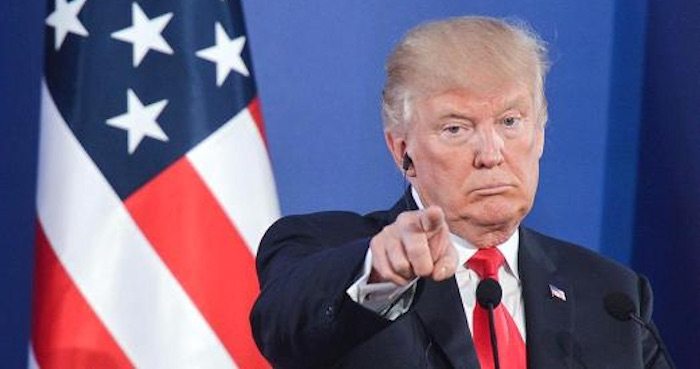
Decertifying the nuclear deal without walking away gives the Trump administration an opening to confront the Islamic Republic’s foreign meddling.
President Donald Trump is taking considerable heat for his expected announcement this week that he will “decertify” the 2015 Iran nuclear deal. Critics say he is heedlessly discarding a deal that has been working, and needlessly putting America on a collision course with Iran.
As it turns out, Trump is actually not poised to “rip up the deal.” By decertifying it, the president and his advisors are, in fact, signaling their intent to strengthen it, with the help of Congress, so that the deal advances U.S. national security interests. Those interests are key criteria for the certification process, which takes place every 90 days, as laid out in the Iran Nuclear Agreement Review Act (INARA) of 2015. Right now, with the Iranians hindering inspection of military sites, working feverishly on their ballistic missile program, and banking on the nuclear deal’s sunset clauses, which all but guarantee Tehran an advanced nuclear program in roughly a decade, it’s hard to argue the deal is working for the United States.
Decertification has the potential to change all of that. The move will plunge Iran and the other parties involved in the nuclear deal into a state of limbo. It will prompt all sides to consider what the deal is worth to them, and what further compromises they may be willing to make to satisfy the national interests of the United States, as laid out by the Trump administration.
Related: Ending the Iran Deal is An Invitation to War
Related: Two Years on, the Iran Deal is Working
Under President Barack Obama, whose foreign-policy legacy was anchored to the nuclear deal, the promise of deferring (not preventing) Iran’s nuclear ambitions superseded all else. As a result, the fear of Iran walking away paralyzed Washington and prevented the Obama White House from making even reasonable demands of Tehran. The credible threat of a U.S. response to Iranian aggression was effectively off the table. So was the imposition of meaningful new sanctions, for that matter.
The coming decertification announcement provides an opportunity to break this paralysis. Trump is effectively telling Tehran that he sets the terms for the nuclear deal because he is not tethered to its success the way Obama was. The administration will then have a chance to chart its own Iran policy. As the 60-day INARA review period plays out, Trump can regain U.S. leverage, establish new red lines on Iranian behavior, and (unlike his predecessor) actually enforce them. If he does it right, he can do all of this without exiting the deal.
In response to decertification, Iran’s leadership will undoubtedly threaten to walk away from the table. But it’s not that simple. There are benefits the Iranians have yet to reap from the deal—beyond the more than $100 billion in released oil funds—ranging from increased foreign investment to greater integration with the global economy after years of economic isolation. In other words, Iran can still cash in considerably, but not if it balks at Trump’s calls to fix the deal.
The Europeans, Russians, and Chinese, are also reluctant to go along with Trump’s certification gambit. Some are already howling with disapproval. But some are already voicing their willingness to work with the White House. As the primary investors in Iran’s recent economic rebound, they have little choice but to try to resolve American concerns.
Of course, even the Chinese, Russians, and Europeans understand that they have a daunting task ahead of them. Iran is on a collision course with the West, one that has little to do with the nuclear file. Rather, it is about what the nuclear deal negotiators chose to ignore: Iran’s aggression across the Middle East.
Iran has harassed American ships in the Persian Gulf, held American sailors at gunpoint, bankrolled the murderous Assad regime in Syria, supported the Houthi rebels in Yemen, and furnished the majority of Hezbollah’s operating budget. And those are just a few of the highlights.
Tehran’s broader efforts to dominate the Middle East are also intensifying. From the deployment of its Revolutionary Guard Corps to far-flung corners of the region to the conscripting of Shiite irregular proxies to fight or hold territory in Syria and Iraq, Iran’s footprint continues to grow.
For American policymakers, Iran’s bid for regional hegemony is just as troubling as its nuclear ambitions. Together, they represent a dual Iranian strategy that cannot be separated, despite the P5+1’s efforts to do so back in 2015. This is why Trump should build on his decertification announcement with the rollout of a new Iran policy that actively counters these activities.
As it happens, the timing is fortuitous. The administration is slated to complete and roll out its Iran Policy Review by October 31st. If the policy lives up to the hints dropped by senior officials, the United States will once again push back on Iran’s malign behavior. If done right, it will do so wherever possible, and by using every pressure point available.
Such a policy would include designating the Revolutionary Guards as a terrorist group (a move mandated by statute by October 31st), but also new tranches of Treasury sanctions on Iranian bad actors, and other economic pressure. The financial targets figure to be non-nuclear in nature, to ensure that the United States remains compliant with the nuclear deal. But the pressure should be palpable.
From there, Washington is also expected to actively target Hezbollah, Iran’s most powerful and active proxy. The Trump administration and Congress have already signaled they will take aim at Hezbollah’s economic interests, while also weakening their positions across the Middle East.
Beyond that, Washington can take further steps to strengthen America’s allies, such as the Sunni Arab states and Israel, who are also willing to challenge Iranian aggression. This could mean greater intelligence-sharing and bilateral cooperation, but could also include new hardware and military capabilities. More broadly, the United States must signal that Iranian threats to its allies will be seen as threats to the United States itself.
Admittedly, none of this will be easy. The Middle East is a dangerous region that doesn’t respond well to change. The same can be said for Washington in the Trump era. But whatever challenges loom will be the cost of shattering the paralysis in Washington that has reduced America’s Iran policy to a false binary of either hewing to the nuclear deal or war.
The choices to counter Iranian aggression before the nuclear deal were many. President George W. Bush understood this at the tail end of his presidency. President Obama even understood this at the beginning of his. But Obama then chose to limit his options through the nuclear deal. This has not served America well. It’s time to restore those options. Decertification and a new Iran policy, if done right, can potentially put America back in the driver’s seat after two years of going along for the ride.