



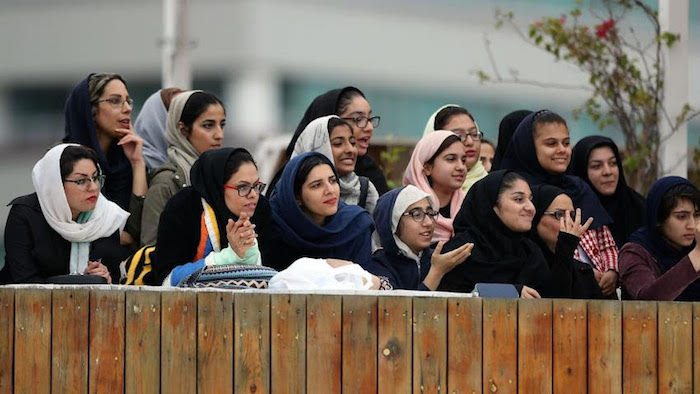
Iran, bowing to external pressure, has allowed women spectators to attend a premier international men’s volleyball tournament on the island of Kish. The Iranian concession constitutes a rare occasion on which the Islamic republic has not backtracked on promises to international sports associations to lift its ban on women attending men’s sporting events. Human rights groups hailed the move as a positive, albeit small step forward.
The Iranian concession appeared to contradict Iranian Foreign Minister Mohammad Javad Zarif’s hard line towards international pressure in the wake of renewed sanctions imposed by US President Donald J. Trump. “Everybody has tested Iran over the past 38 years and they all know that Iran is hardly moved by threats. We do not respond very well to threats. We respond very well to respect and mutual respect and mutual interest,” Mr. Zarif told CNN’s Christian Amanpour this weekend on the side lines of the Munich Security Conference.
In contrast to Mr. Zarif’s assertion, the Iranian concession followed a decision by the Federation Internationale de Volleyball (FIVB) to dump its quiet diplomacy approach towards Iran and revert to public pressure. The FIVB threatened on the eve of the Kish tournament to suspend the event if Iran failed to grant women spectators access. Iran alongside Saudi Arabia is the only country that bars women spectators from attending men’s sporting events.
“From now on women can watch beach volleyball matches in Kish if they observe Islamic rules,” said Kasra Ghafouri, acting director of Iran’s Beach Volleyball Organisation.
The FIVB has flip flopped in its attitude towards Iran. The group initially took a lead among international sports associations in publicly declaring that it would not grant Iran hosting rights as long as women were not given unfettered access to stadia. In response, Iran promised to allow women to attend international volleyball tournaments in the Islamic republic. Taking Iranian authorities by their word, women travelled last year to Kish for the 2016 tournament only to discover that Iran would not make good on its promise.
Rather than demonstrating sincerity by following through on its threat, the FIVB said it would not sanction the Islamic republic because gender segregation was culturally so deep-seated that a boycott would not produce results. Instead, the federation argued that engagement held out more promise. The decision flew in the face of the facts. Gender segregation in volleyball in Iran was only introduced in 2012, 33 years after Islamic revolutionaries toppled the Shah. Senior volleyball executives said at the time that the FIVB feared that a boycott would put significant revenues at risk.
The FIVB’s change of attitude was seemingly backed by the United States. The US Volleyball Federation on the informal advice of the State Department decided at the time not to send its woman president to Iran when the US national team played there even though the vice president of Iran is a woman and Iranian sports associations have women’s sections that are headed by women.
Ultimately, quiet diplomacy did not pan out, prompting the FIVB to return to a proven tactic, the very threats that Mr. Zarif asserted would not work. Mr. Ghafouri referred in his statement exclusively to Kish, a resort island and free trade zone in the Gulf far from the Iranian heartland known for its somewhat more relaxed enforcement of strict Islamic mores. The litmus test for both Iran and the FIVB’s sincerity in ensuring women spectators’ access to international volleyball events is likely to be this June’s FIVB Volleyball World League in the capital Tehran.
The FIVB’s success in ensuring women’s access to the Kish tournament is remarkable given that Iranian President Hassan Rouhani is locked into a tough battle in advance of presidential elections in May that could make him the first Iranian head of state not to serve a second term in more than three decades. Many Iranians are disappointed that Iran’s nuclear agreement that lifted crippling international sanctions and was championed by Mr. Rouhani has failed to meet popular expectations of a swift trickledown effect.
Mr. Rouhani is embroiled in a power struggle with powerful domestic forces like the Revolutionary Guards eager to ensure that Iran’s return to the international fold does not affect their vested interests. Women’s sporting rights do not figure high on Mr. Rouhani’s agenda in this struggle against the backdrop of Mr. Trump has calling the nuclear agreement into question.
Moreover, in contrast to soccer, volleyball has been largely a battle between an international sporting association and Iranian authorities rather than a struggle by Iranian women. British-Iranian national and law student Ghoncheh Ghavami became the exception when she and several others attempted in June 2014 to attend a Volleyball World League match at Tehran’s Azadi Stadium. Ms. Ghavami was charged with “propaganda against the state,” and held in Iran’s notorious Evin Prison for months.
Iranian women disguised as boys or men have, however, repeatedly over the years sought to enter Azadi Stadium, during soccer matches, Iran’s most popular sport. An attempt by eight women wearing men’s clothes, short hair and hats was foiled last month when they were arrested at the entrance to the stadium.
A BBC Persian reporter, one of the few Iranian women to have ever officially attended a post-revolution soccer match in Azadi Stadium, recently countered with her own experience Iranian justification of the ban on the grounds that it was designed to shield women from men’s rowdiness in sport stadia and to pre-empt the temptation of genders mixing.
In the stadium as a translator for a television crew during a 2006 World Cup qualifier, men wildly celebrating Iran’s victory made a path for her as she struggled to make her way through a crowd to a news conference. “They behaved much better, contrary to what the authorities think. If we have women in stadiums, men will behave much better,” the reporter said.
Dr. James M. Dorsey is a senior fellow at the S. Rajaratnam School of International Studies, co-director of the University of Würzburg’s Institute for Fan Culture, and the author of The Turbulent World of Middle East Soccer blog, a book with the same title, Comparative Political Transitions between Southeast Asia and the Middle East and North Africa, co-authored with Dr. Teresita Cruz-Del Rosario and a forthcoming book, Shifting Sands, Essays on Sports and Politics in the Middle East and North Africa