
Close Menu
    Facebook Instagram LinkedIn
    • العربية (Arabic)
    • English
    • Français (French)
    Facebook Instagram LinkedIn
    Middle East Transparent
    • Home
    • Categories
      1. Headlines
      2. Features
      3. Commentary
      4. Magazine
      5. Cash economy
      Featured
      Headlines Khalil Youssef Beidas

      The Panic Seeps to Dodge City

      Recent
      25 January 2026

      Federalism Is the Only Shield Lebanon and Iraq Have Left in a Nuclearizing Middle East

      25 January 2026

      The Panic Seeps to Dodge City

      23 January 2026

      Inside the Bank Audi Play: How Public Money Became Private Profit

    • Contact us
    • Archives
    • Subscribe
    • العربية (Arabic)
    • English
    • Français (French)
    Middle East Transparent
    You are at:Home»Categories»Features»About one-fifth of adults globally have no formal schooling

    About one-fifth of adults globally have no formal schooling

    0
    By Pew on 30 January 2017 Features

    BY DAVID MASCI

    In many parts of the world, particularly in poorer countries, attainment of even the most basic education is still far from universal. Indeed, roughly one-in-five adults (19%) around the globe have no formal schooling at all, according to a recent Pew Research Center report on education that also studied its relationship to religion.

    While virtually all adults in Europe (98%) and English-speaking North America (99%) have at least some education, four-in-ten in the Middle East and North Africa (41%) and in sub-Saharan Africa (41%) have not completed even a year of primary school.
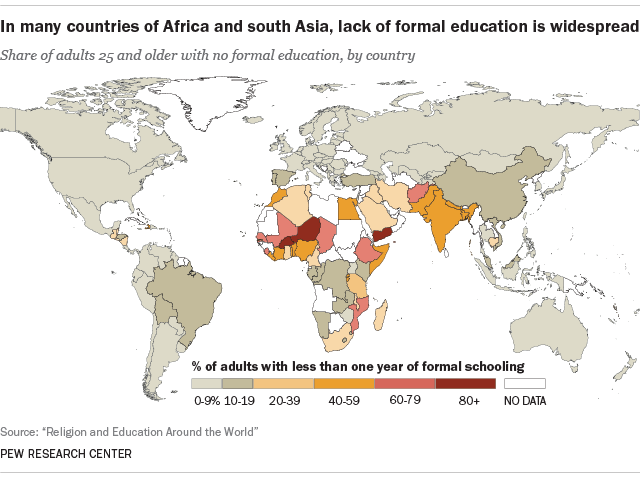
    In the Asia-Pacific, the world’s most populous region, 22% of adults have no schooling. And in Latin America and the Caribbean, one-in-ten have no education. 

    Women are more likely to have no schooling than men. Nearly a quarter (23%) of women are uneducated, compared with 14% of the world’s men. In the least educated parts of the world (Middle East-North Africa and sub-Saharan Africa) roughly half of adult women have not been to school for even a year.

    In addition, older adults are more likely to have no education than younger ones. About a quarter of those who in 2010 were between the ages of 55 and 75 have no schooling. By contrast, among those who in 2010 were between the ages of 25 and 34, the share without education is 15%, a sign that more people are now going to school than four or five decades ago.

    Among the young, there also is less of a gender gap. Among men and women between the ages of 55 and 75, 19% and 34% have no education, a 15% difference. But among those between the ages of 25 and 34, the gap between men with no schooling (12%) and women (19%) is only 7%.

    In certain countries in sub-Saharan Africa (Burkina Faso, Mali, and Niger), the share of those without education is roughly eight-in-ten or higher. The same is true for Yemen and Afghanistan. In Europe, 12% of all adults in Portugal and Spain have no schooling, the highest shares on the continent. And in the Western Hemisphere, the country with the highest share of uneducated adults is Haiti (54%).

    Pew Research Center

    Share. Facebook Twitter LinkedIn Email WhatsApp Copy Link
    Previous ArticleSaddam Hussein Seriously Feared a U.S. Nuclear Strike During the Gulf War
    Next Article Jordan’s King Abdullah Visits Trump’s Washington
    Subscribe
    Notify of
    guest
    guest
    0 Comments
    Newest
    Oldest Most Voted
    Inline Feedbacks
    View all comments
    RSS Recent post in french
    • Au Liban, des transactions immobilières de l’OLP suscitent des questions 18 January 2026 L'Orient Le Jour
    • Pourquoi la pomme de la tyrannie tombe-t-elle toujours ? 10 January 2026 Walid Sinno
    • La liberté comme dette — et comme devoir trahi par les gouvernants 2 January 2026 Walid Sinno
    • La « Gap Law »: pourquoi la précipitation, et pourquoi les Français ? 30 December 2025 Pierre-Étienne Renaudin
    • Au Liban, une réforme cruciale pour sortir enfin de la crise 23 December 2025 Sibylle Rizk
    RSS Recent post in arabic
    • لِشهرين أم لِسنتين: الانتخابات النيابية مؤجّلة حُكماً! 25 January 2026 كمال ريشا
    • ثرثرة على ضفة الحركة (2): “الفلسطينيّة” و”العربيّة” 25 January 2026 هشام دبسي
    • الهَلَع يتسرَّب إلى دودج سيتي 25 January 2026 خليل يوسف بيدس
    • قضية “بنك عودة”: كيف تحوّلت الأموال العامة إلى أرباح خاصة 24 January 2026 سمارة القزّي
    • حوارٌ ضروري حول قبرص، والأمن، ونصف القصة الغائب 24 January 2026 يوسف كانلي
    26 February 2011

    Metransparent Preliminary Black List of Qaddafi’s Financial Aides Outside Libya

    6 December 2008

    Interview with Prof Hafiz Mohammad Saeed

    7 July 2009

    The messy state of the Hindu temples in Pakistan

    27 July 2009

    Sayed Mahmoud El Qemany Apeal to the World Conscience

    8 March 2022

    Russian Orthodox priests call for immediate end to war in Ukraine

    Recent Comments
    • Nadim Shehadi on The Panic Seeps to Dodge City
    • Yusuf Kanli on A necessary conversation: On Cyprus, security, and the missing half of the story
    • Mohamed on Inside the Bank Audi Play: How Public Money Became Private Profit
    • JudgmentalOne on A necessary conversation: On Cyprus, security, and the missing half of the story
    • Drivers Behind Audi’s Top-Level Management Shake-Up - Middle East Transparent on Lebanon’s banks are running out of excuses
    Donate
    © 2026 Middle East Transparent

    Type above and press Enter to search. Press Esc to cancel.

    wpDiscuz