



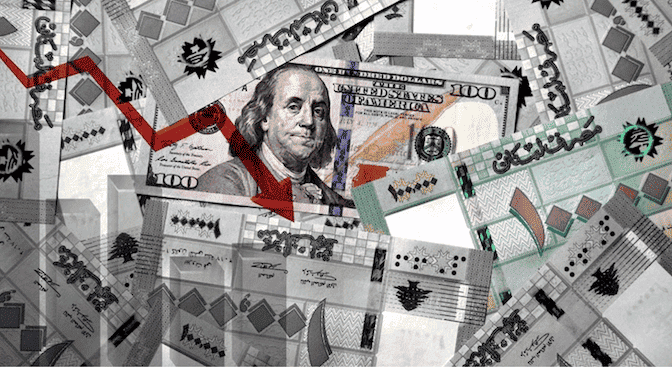
Lebanon’s financial crisis has not been resolved. It has merely been deferred.
After one of the most severe currency collapses in recent economic history, the Lebanese pound (Lira) has been held at roughly 89,500 to the US dollar, a level that appears, at least superficially, to signal a return of stability after years of hyperinflation.
But this calm is not the result of reform or renewed confidence. It is the product of extreme fiscal compression and monetary improvisation. The longer Lebanon delays a credible adjustment, the more disruptive the eventual correction will be.
From Collapse to Containment
Lebanon’s crisis erupted in 2019, when its financial model, built on unsustainable debt accumulation, banking sector fragility, political dysfunction, and a state hijacked by Hezbollah the Iranian militia finally imploded. The government defaulted on its sovereign obligations without a restructuring strategy, triggering a rapid unravelling of the long-standing currency peg at 1,500 pounds per dollar.
What followed was not a managed depreciation but a hyperinflationary spiral. The exchange rate collapsed in successive waves, reaching nearly 89,500 per dollar and destroying domestic purchasing power.
Today’s exchange rate stability, however, has not emerged from a coherent macroeconomic framework. It has been imposed through suppression.
Stability Through Fiscal Paralysis
Rather than undertaking fiscal reform, restructuring the banking system or restoring institutional credibility, the Lebanese state has relied on an unusually blunt mechanism: an effective freeze in public spending.
Government expenditure has been compressed to the bare minimum. Ministries have been starved of operational budgets. Public investment has vanished. Outside of limited social welfare payments, the state has largely ceased to function as an economic actor.
This approach may reduce immediate pressure on the currency. But it is not sustainable. It represents stability through exhaustion rather than recovery.
Account 36 and the Liquidity Trap
The central bank has managed to stabilise the pound partly by absorbing liquidity. Taxes are collected in local currency, while spending remains heavily constrained. The result is the accumulation of large lira balances in what is known as Account 36 at the Central Bank, Banque du Liban.
These balances are estimated at the equivalent of $6 bn, reflecting not only higher tax extraction but also the state’s inability, or refusal, to deploy funds into the economy.
In effect, the government is sterilising domestic liquidity by withholding expenditure. This temporarily supports the exchange rate. But it also creates a latent overhang: once fiscal demands force spending to resume, these pounds will re-enter circulation rapidly.
In an economy where confidence in the currency is minimal, the conversion of released lira into dollars would be immediate — and destabilising.
A Currency Regime Built on Distortion
Lebanon’s exchange rate system remains fragmented. While the market rate trades near 89,500, banks continue to pay depositors at an official withdrawal rate of 15,000. This implies that depositors accessing their trapped dollar savings are effectively receiving less than 20 per cent of their value. To take it up to 89,500 means printing more lira.
This is not monetary policy. It is an unresolved banking insolvency being managed through de facto depositor losses.
Absent a restructuring framework, the financial system remains suspended in a state of denial, with multiple exchange rates functioning as instruments of political delay rather than economic adjustment.
Dollarisation and the Hollowing Out of the Pound
The private sector has already moved beyond the Lebanese pound. Prices, wages and transactions in much of the economy are now effectively dollarised. The lira persists mainly in the public sector, for government salaries and tax payments.
This reduces the currency’s role to an” administrative unit” rather than a credible medium of exchange. It also makes the current exchange rate particularly fragile: demand for lira is no longer broad-based, and stability is maintained largely through coercive constraint rather than confidence.
Devaluation Deferred Is Devaluation Amplified
Lebanon has effectively reset its currency from 1,500 to 89,500 without establishing the institutional or fiscal foundations necessary to sustain any exchange rate regime. The current level is defended not through productivity or capital inflows, but through spending paralysis, liquidity suppression and continued financial repression of depositors.
Such a strategy cannot endure indefinitely. Infrastructure is deteriorating, state capacity is eroding, and the fiscal freeze is pushing institutional breakdown closer.
The longer adjustment is postponed, the greater the eventual dislocation.
Conclusion: A Pause, Not a Resolution
Lebanon’s exchange rate stability is not evidence of recovery. It is evidence of containment.
An overvalued currency is being held in place through measures that delay rather than resolve underlying insolvency. Without credible reforms — including bank restructuring, fiscal normalisation and exchange rate unification — a second devaluation is not a risk but an inevitability.
The pound is not stable.
It is simply waiting for the next shock.