



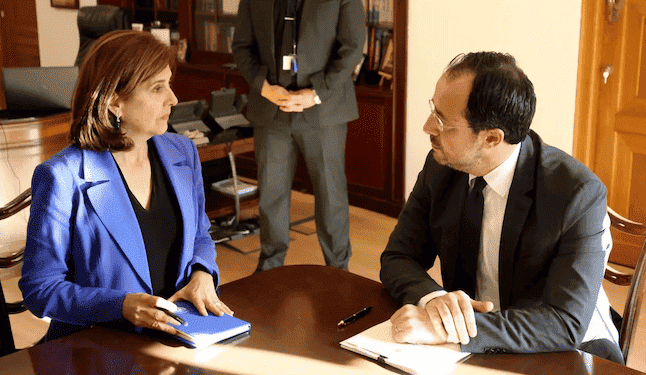
As the UN Secretary-General’s special envoy Maria Angela Holguín Cuéllar prepares to test the waters on December 11 at what will be the first trilateral meeting in five years, in order to assess whether conditions are suitable for a third informal 5+1 conference on Cyprus, the island’s two leaders appear to agree on only one point: something needs to move. Beyond that, their approaches are so far apart that the real question is no longer whether a 5+1 meeting can be held, but whether it would achieve anything at all.
Turkish Cypriot leader Tufan Erhürman frames the 5+1 as a conditional and sequenced process, one that must be carefully prepared in Nicosia before any high-level engagement. Greek Cypriot leader Nikos Christodoulides, meanwhile, repeats a familiar refrain: Cyprus should “continue from where we left off in Crans-Montana.”
The contrast reveals not just tactical divergence, but a deeper philosophical split about what went wrong in 2017 — and what it would take to avoid another collapse.
Erhürman’s position is neither rejectionist nor passive. It is conditional, structured and explicit. He has been stressing, “Yes to 5+1, but only when the ground is ready.”
He supports, in principle, the UN’s intention to convene a third 5+1. But he insists that the two sides must first do their homework and put something worthy on the agenda:
Only then, he argues, can the Secretary-General, Türkiye, Greece and the UK be brought into a meaningful format.
Erhürman’s critique of previous attempts is blunt: “The weight of the table was not matched by the weight of the issues. We cannot repeat that mistake.”
Earlier 5+1 meetings dealt with crossing points, buffer-zone solar panels and cemetery cleaning — issues that should never have required the presence of three guarantors and the UN chief. The new Turkish Cypriot leader is determined not to convene another conference “just for the sake of convening one.”
Christodoulides: The old mantra
On the Greek Cypriot side, the messaging is far simpler and far more repetitive. Christodoulides has said, in nearly every public statement, that he is ready to pick up the process from where it ended in Crans-Montana in July 2017.
To Greek Cypriot audiences, this is framed as demonstrating consistency. But the position avoids addressing the central question: why did the process collapse in the first place? Witness accounts, memoirs and UN reporting confirm that on the final night in Crans-Montana, then-President Anastasiades — with Christodoulides as his close aide — categorically rejected rotational presidency, a core component of political equality as defined by the Security Council.
For Erhürman, this history cannot be ignored: “If the point at which you left the table was so desirable, why did you walk away? There has been no answer for eight years.”
Thus, while Christodoulides invokes Crans-Montana as a symbolic starting point, Erhürman views it as the last place anyone should start unless the political equality issue is resolved first.
The core divide: Political equality
This is not simply a matter of legalistic interpretation. It goes to the heart of the power-sharing model.
According to Erhürman, political equality is:
His logic is methodological: entering a process without clarifying this principle risks another “last-night collapse.”
The Greek Cypriot leader, on the other hand, publicly endorses “political equality” but does so in a broad, undefined and evasive manner. He avoids confirming that this includes rotational presidency or effective participation as understood by the UN.
This ambiguity is not accidental. It is increasingly shaped by Christodoulides’s desire for re-election and the domestic calculations that now dominate his political orbit. The most recent cabinet reshuffle, widely interpreted as an attempt to court hardliners and the far-right ELAM, signals a deliberate shift toward a more nationalist posture. Rather than broadening the political centre, Christodoulides appears to be consolidating the right, positioning himself as the preferred candidate of constituencies traditionally hostile to compromise.
This recalibration may serve his electoral ambitions, but it deepens the structural deadlock. For Turkish Cypriots, the overt attempt to appease ELAM — a party with a long record of rejecting even the concept of political equality — is not merely concerning but profoundly irritating. It reinforces the belief that Christodoulides’s public flexibility is performative, while his real political incentives push him further away from any solution requiring shared power.
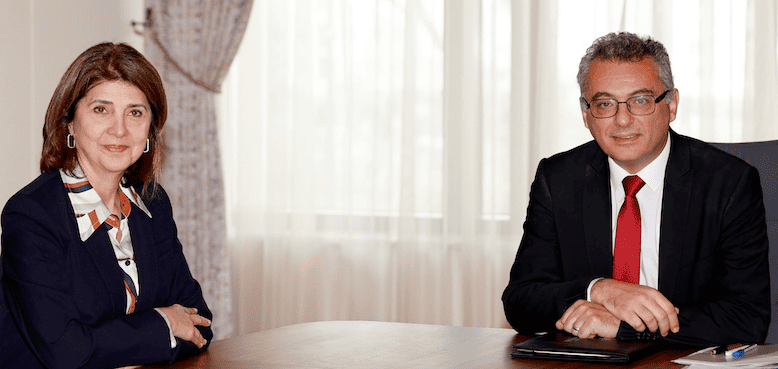
But for Erhürman, ambiguity is unacceptable: “We cannot spend months negotiating only to hear another ‘categorical rejection’ in the final hours.”
The contrast is not simply negotiating style; it is negotiating architecture — one leader trying to create pre-conditions for a viable process, the other navigating electoral currents that reward intransigence rather than compromise.
Building trust: one leader offers specifics, the other rhetoric
Erhürman has proposed a 10-point conducive climate package, including:
These are small yet symbolic measures. They test whether the Greek Cypriot side is willing to take any step that benefits both communities.
Christodoulides, by comparison, speaks of confidence building in general, thematic terms, often outsourcing responsibility to the UN or the EU. Few concrete proposals have been put forward; even fewer have been implemented.
The gap between rhetoric and implementation remains wide.
The regional dimension: New risks, new players, old patterns
Erhürman repeatedly stresses that Cyprus is no longer — if it ever was — a purely intercommunal problem. The island now sits within a dense web of regional security developments:
The exclusion is not accidental, he argues. It is deliberate — and destabilizing: “We are not a community that merely receives a share. We are a co-owner. Our consent must be part of the decision-making.”
Christodoulides frames these agreements as “strategic partnerships” with Europe and the democratic world. But from the Turkish Cypriot and regional perspective, they reinforce the impression of a unilateral authority structure — the very thing the 1960 Constitution was designed to prevent.
Would a 5+1 succeed under these conditions?
According to Erhürman a 5+1 without preparation is worse than no 5+1 at all. It risks:
Thus, his insistence on sequencing is not obstructionism; it is risk management.
The Greek Cypriot leader, on the other hand, considers a 5+1 is desirable precisely because it restores a familiar pattern: International pressure on Türkiye and political cover for the Greek Cypriot side. The call to “resume where we left off” allows him to sidestep politically costly concessions while projecting readiness. But the structure he proposes is the same one that failed.
Two visions, two trajectories
A third 5+1 can only be meaningful if the two leaders share:
At present, they do not. Erhürman is asking for clarity, sequencing and trust-building.Christodoulides is asking for continuity without clarification.
In the narrow tactical sense, both approaches make political sense for their respective constituencies. But from a negotiation-theory perspective, and from the vantage point of Cyprus’s long diplomatic history, the gap between the two logics is wide enough to make a 5+1 fragile from the outset. Unless that gap narrows, a third 5+1 risks becoming not the beginning of a renewed process, but another milestone in a long series of missed opportunities.