



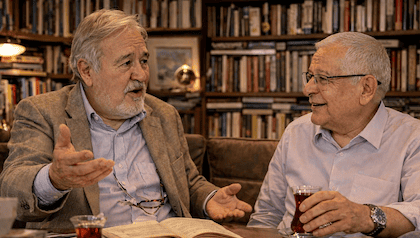
There are moments when the passing of a single individual leaves a silence far larger than the loss of a human life. The death of Prof. Dr. İlber Ortaylı is such a moment. For Türkiye, and indeed for the broader intellectual world that followed his work, his passing feels less like the departure of a historian and more like the dimming of a living library.
The sadness is profound and widely shared. It is felt by his family, who have lost a beloved father and relative. It is felt by colleagues who debated history with him for decades. It is felt by students whose intellectual horizons were shaped by his lectures. And it is felt by millions of readers and admirers across Türkiye and abroad who came to see in him one of the rare figures capable of making centuries speak with clarity and passion.
For me the loss carries a deeply personal dimension. I first came to know İlber Ortaylı in 1978, when I was a young reporter trying to find my footing in the demanding intellectual environment of Ankara. Even then he stood out as an extraordinary presence. His knowledge, his command of language, and his unmistakable intellectual authority made it immediately clear that he was not merely another academic voice. He was a scholar who carried entire historical worlds within his memory.
Over nearly five decades our paths crossed many times, sometimes in formal protocol settings, sometimes in official gatherings, and occasionally in quieter environments where conversation could wander freely across centuries. Each encounter reinforced the same impression. Ortaylı did not merely study history. He lived inside it.

Roots in the Crimean world
Understanding İlber Ortaylı’s intellectual temperament requires beginning with his origins. Born in 1947 in Bregenz, Austria, he was the son of a Crimean Tatar family whose historical memory stretched across the Black Sea world.
The Crimean Tatars represent one of the most historically significant communities of the region, a people whose story intersects with the Ottoman Empire, the Russian Empire and the turbulent geopolitical transformations of the twentieth century. Growing up within such a cultural inheritance meant that history was never a distant academic subject. It was part of family memory and collective identity.
His family later settled in Türkiye, where Ortaylı developed a profound attachment to the country that became his intellectual home. He was deeply devoted to the secular republican principles that shaped modern Türkiye. At the same time he possessed an equally deep appreciation for the cultural and historical layers that had accumulated across Anatolia over centuries.
For Ortaylı there was never a contradiction between these two dimensions. The Ottoman past and the republican present were not competing narratives but successive chapters of a long and complex historical continuum.

A scholar of extraordinary range
Few historians of his generation possessed such formidable intellectual breadth. After studying at Ankara University’s Faculty of Political Sciences, Ortaylı continued his academic journey in Europe, immersing himself in the archival traditions of multiple historical cultures.
His linguistic abilities became legendary. Turkish, Ottoman Turkish, Russian, German, French, Italian and several other languages formed part of his scholarly toolkit. Through them he was able to engage directly with primary sources across different imperial archives.
This multilingual scholarship gave Ortaylı a perspective that transcended narrow national narratives. His work placed the Ottoman Empire within a wider network of imperial systems stretching from Central Europe to the Mediterranean and the Black Sea.
He examined Ottoman governance not through romantic nostalgia or ideological simplification but through rigorous institutional analysis. Provincial administration, legal systems, bureaucratic structures and diplomatic networks all formed part of the historical architecture he sought to understand.
Students leaving his lectures often felt they had traveled through centuries of imperial administration in a single afternoon.
Istanbul: A city he carried in his mind
If there was one city that defined Ortaylı’s intellectual imagination, it was Istanbul.
For him Istanbul was not simply a metropolis. It was a living archive of civilizations. Byzantine foundations, Ottoman imperial institutions, republican transformations and countless cultural layers coexisted within its streets.
Few people knew the city with such intimacy.
Walking through Istanbul with Ortaylı was like reading a living manuscript. Every fountain, every mosque courtyard, every library and every forgotten kiosk could open a historical narrative.
His ability to deliver hours-long lectures on seemingly modest architectural features became legendary. A simple Ottoman fountain might lead to discussions of urban administration, charitable foundations, imperial patronage and aesthetic philosophy. A small neighborhood mosque might open a window into centuries of legal traditions and social organization.
Listening to him speak about the city meant witnessing history unfold through architecture and memory.

The guardian of Topkapı Palace
Perhaps no place symbolized Ortaylı’s connection to Ottoman civilization more vividly than Topkapı Palace.
For several years he served as director of the Topkapı Palace Museum, the very heart of Ottoman imperial governance for centuries. The palace had been the administrative and ceremonial center of an empire that stretched across three continents.
Under Ortaylı’s stewardship the palace was treated not merely as a monument for visitors but as a historical organism whose rooms, courtyards and archives embodied the workings of imperial power.
He knew the palace in astonishing detail. From the imperial council chamber to the palace kitchens, from the treasury to the harem complex, he could reconstruct the rhythms of Ottoman administration as if the court had only recently departed.
Those fortunate enough to hear him lecture within the palace walls experienced something unforgettable. Silent rooms suddenly filled with the presence of sultans, scribes, diplomats and artisans whose lives had shaped the empire.
A mind that refused intellectual shortcuts
One characteristic that defined Ortaylı’s public persona was his impatience with superficial thinking. He rejected simplified historical narratives and ideological clichés. In an era when historical discourse often collapses into slogans, Ortaylı insisted on nuance, complexity and institutional understanding.
This intellectual discipline sometimes made him appear stern. Yet beneath that sternness lay a profound respect for scholarship itself. He believed deeply that history demanded linguistic competence, archival engagement and comparative analysis.
Those who approached him with genuine curiosity encountered an extraordinarily generous teacher. Those who approached history lightly discovered the sharp precision of his wit.
A public intellectual for a nation
Beyond academia Ortaylı became one of the most recognizable historical voices in Türkiye. Through books, television programs and public lectures he brought historical inquiry into the daily intellectual life of the country.
Millions encountered Ottoman history, urban culture and imperial diplomacy through his explanations. Yet he never simplified history merely to entertain. He insisted that the public deserved serious knowledge.
In doing so he cultivated a historical consciousness among readers and viewers who might otherwise never have engaged with archival scholarship.
Personal memories of a remarkable mind
For those of us who had the privilege of knowing him personally, today’s loss feels particularly heavy.
I recall many conversations over the years, some formal, others spontaneous. At official receptions he might appear skeptical of ceremonial routines. But the moment discussion turned to archives, cities or languages, the historian emerged instantly.
His eyes sharpened, his tone animated, and the conversation would travel effortlessly from Ottoman provincial reforms to European diplomatic history or the cultural geography of the Black Sea.
Even in casual conversation one could sense the disciplined mind of a scholar shaped by decades of reading and reflection.
The historian who made the past speak
Today Türkiye mourns not merely an academic figure but a guardian of cultural memory.
His family mourns a beloved father. His students mourn a teacher whose intellectual guidance shaped their lives. His colleagues mourn a formidable historian. And millions across Türkiye and beyond mourn a voice that helped them rediscover the richness of their past.
Yet history reminds us that intellectual legacies endure long after the voices that created them fall silent. They survive in books, in institutions, in students and in the curiosity they inspire.
İlber Ortaylı spent a lifetime reminding us that history is not dead. It lives in cities, in languages, in institutions and in the collective memory of societies.
Today the historian is gone. But the centuries he illuminated will continue to speak through his work.