



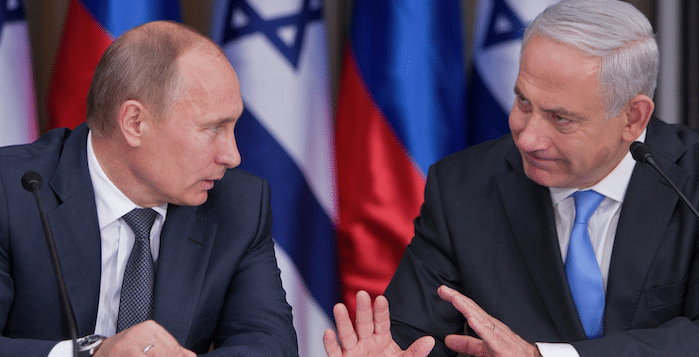
Ng.ru’s military “observer” Vladimir Mukhin posted an article titled “Moscow Is Changing the Astana Format for The Russian Israeli One” on February 28, 2019. Instead of reliance upon Turkey and Iran, the basis of the peacekeeping force in the north of Syria will be composed of Russia’s military police and contingents from the international coalition. Mukhin explained that Russia is disenchanted with its allies in Syria Turkey and Iran. Both are needlessly interfering with Russia’s ambitions in Syria. Turkey under the cover of fighting Kurdish terrorists is coveting more Syrian lands, while Iran in its struggle with Israel is also seeking to expand its presence thus preventing the regional stability that Moscow wants. A formula that would obtain the withdrawal of foreign forces (Turkish, Iranian and American) leaving essentially the Russian military police presence was presumably worked out with Binyamin Netanyahu during his visit to Moscow.
Mukhin’s article follows below:
“The main accomplishment of Israeli PM Binyamin Netanyahu’s visit to Moscow, as reported by the Israel media is the possible formation of a working group of Russia, Israel and a series of other countries with a view to extracting foreign forces from Syria. This is what was related on Wednesday by high ranking Israeli officials
“Objective preconditions exist for such a decision by Israel and Moscow, who are striving for stabilization in Syria. The terrorists of the Islamic State (ISIS is banned in Russia) are essentially defeated. The regime of Syrian president Bashar Assad with Moscow’s support is embarking on a peaceful existence and is trying to consolidate various forces as part of an internal dialogue.
“It cannot be excluded, that in the discussions between Russian President Vladimir Putin and the Israeli premier a long-term strategy for the attainment of common goals was already worked out. We are talking about a compromise in accordance with the interests of the parties that are uninterested in the presence of Iranian forces in Syria as well as the Turkish army (fighting against the Kurds) as well as coalition forces headed by the U.S.
“US President Donald Trump has already announced the withdrawal of his soldiers from Syria. And the remaining limited peacekeeping contingent of the Pentagon that remains should defend the Kurds whom Moscow and Tel-Aviv also support. Simultaneously, it can be assumed that the joint Russia-Israel group can via political methods (via the U.N., other international institutions, etc.) can act in concert against the Iranian-Turkish presence in Syria. True, for this Moscow will apparently need to ‘bury’ relations with Ankara and Tehran in the ‘Astana Format’ framework.
“Judging by the announcement of the Israeli leadership, the country’s armed forces after Netanyahu’s visit to Russia intend to continue destroying Iranian military targets in Syria. Moscow, as long as Russian servicemen are not harmed, will not interfere. It should be noted that relations between Moscow and Tehran on that week grew increasingly tense. Iran.ru, an internet portal close to official Tehran cites Nasser Kandil[1] a Shi’ite analyst in the Arabic Lebanese paper Al-Binaa who observed that ‘Bashar Assad’s visit to Tehran preceded Binyamin Netanyahu’s trip to Moscow and carried a message that Israel should pay a price for any future attacks on Syria’. And this quite definitely sounded not only a warning to Tel Aviv but also a reproach to the Russian leadership.
“Tension is also increasing in relations with Turkey. Military-diplomatic sources report on Moscow’s plans to expand its military police contingent in the northeast part of the country. Foreign Ministry chief Sergey Lavrov last Sunday did not exclude similar actions by the Russian Defense Ministry.
“The President of Turkey Recep Tayip Erdogan, anticipating the possibility of such developments criticized Lavrov, who chatting with journalists announced that ‘Russia and Turkey have not reached a common understanding on which Kurdish forces should be considered terrorist and which not’. In Lavrov’s words, Ankara has ‘its unique position’. Moscow understands ‘its unease, but it is still necessary to separate the wheat from the chaff and see which of the Kurdish forces are really extremist and constitute a threat to the Turkish Republic.’
“In an interview with the NTV channel, Erdogan responded to Lavrov by declaring that Turkey did not have such problems ‘Over the course of many years my Kurdish brothers have worked as part of my cabinet. Lavrov’s statements are erroneous and it is not right to talk this way. I assume that our foreign affairs minister already gave the necessary warning.’
“The Turkish ambassador to Ukraine, Yamgur Ahmet Gulbere made bellicose statements towards Russia the other day. During an appearance in Kiev at the fourm ‘Occupied Crimea – 5 years of resistance’ he announced. : ‘the Turkish authorities have not recognized and do not recognize the illegal annexation of Crimea. We also share your history and feel all the pain that the Crimean Tatars encountered. He promised the forum’s participants that Turkey ‘will stand shoulder to shoulder with the Crimean Tatars.’
“In this manner, following the normalization of Russia’s relations with Israel, the cooperative relationship of Russia with Iran and Turkey are going through hard times. And that possibly is just the beginning. Moscow is pursuing its own geopolitical interests, and while it does not make loud political statements, it is clearly displeased with the fact that its ‘Astana Format’ partners are needlessly interfering in its relations with Damascus. Turkey under the banner of the struggle with purported Kurdish terrorists covets the occupation of new Syrian lands. Tehran is present in these territories sort of legally, but seeks to strengthen its bases and military facilities there in pursuit of the tremendous tasks of the struggle with the Jewish state [thus]creating addition regional instability.
With such allies, Russia is bound to correct its policy. True the prospect is for a reduced American presence in Syria; Russia, in contrast is broadening its presence there. It has invested significant material and financial resources in that country. “
[1] Kandil is reported to be close to Assad.
Published in MEMRI