
Close Menu
    Facebook Instagram LinkedIn
    • العربية (Arabic)
    • English
    • Français (French)
    Facebook Instagram LinkedIn
    Middle East Transparent
    • Home
    • Categories
      1. Headlines
      2. Features
      3. Commentary
      4. Magazine
      5. Cash economy
      Featured
      Headlines Ronald Sandee

      New Front to be Opened in Kurdish areas of Iran

      Recent
      4 March 2026

      New Front to be Opened in Kurdish areas of Iran

      3 March 2026

      A return to the same process, or a new modality?

      2 March 2026

      The Death of Khamenei and the End of an Era

    • Contact us
    • Archives
    • Subscribe
    • العربية (Arabic)
    • English
    • Français (French)
    Middle East Transparent
    You are at:Home»Categories»Features»The Joint List has no right to exist

    The Joint List has no right to exist

    0
    By Salman Masalha on 24 February 2019 Features

    Let’s pause for a moment to recall the circumstances that led to the establishment of the Joint List. Fear of losing Knesset seats after the electoral threshold was raised pushed the leaders of the diverse Arab parties – Islamists, nationalists and communists – to run together. 

    But running on a single joint ticket didn’t increase the number of Arab Knesset members. Before the formation of the Joint List, the number of Arab lawmakers was almost identical – 12 to 13. That’s the ceiling of what these parties can obtain in an election. Following the Joint List’s establishment, the polls showed no chance of exceeding this ceiling; in many polls, the number even declined.

    Some people say the Joint List is a vehicle for forming a blocking majority that would prevent the establishment of a right-wing government after the election. There could be no greater mistake. Putting all the Arab representatives into a single basket isn’t an obstacle to a right-wing government, but it is an obstacle to the possibility of creating a civic national discourse that crosses ethnic and communal boundaries.

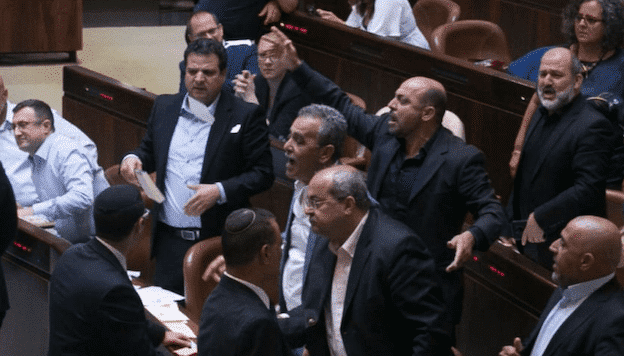
    If all the Arabs are put into a single basket, it’s self-evident that all the Jews will be in another one. The Arab representatives will never have any influence in the Knesset and their votes will never carry any weight. They’ll give speeches (to an empty hall) and even raise an outcry, but there’s no need to sit in the Knesset for this. These actions can be done outside the legislature as well.

    In its current form, the Joint List has no right to exist. It merely plays into the hands of Israel’s overseas propaganda, which boasts that it is the only democracy in the Middle East, including for its Arab citizens. Even worse, the very fact that party affiliation is based on ethnicity only perpetuates the racist separation in Israeli society (See: segregated communities) and gives a parliamentary seal of approval to this separation.

    Given the current situation in Israel, the Arab community, which constitutes a fifth of the country’s population, will always be dependent on goodwill and support from forces within the Jewish majority. The Jewish majority’s support for the just demands of Israel’s Arab citizens must be an interest shared by both Jews and Arabs. But for this to happen, Jews and Arabs must build bridges that link their common interests.

    To do so, Israel needs a consciousness revolution. Such a revolution can come only from the left side of the political map. For the sake of our shared lives in this country, Israeli citizens, Jews and Arabs alike, need a social and political infrastructure that creates bridges among all segments of society, regardless of religion, ethnicity or gender.

    It’s not easy to foment such a consciousness revolution. And it’s doubly difficult against the background of the unending national conflict, which only strengthens the tribal grip on people’s consciousness. To loosen this grip, we must work energetically for a solution on the basis of two states for two peoples.

    All those who have despaired of this solution and have started searching for magical fixes involving a single binational state should be asked how it is that in 70 years, they haven’t even succeeded in laying the infrastructure for binational parties here. As long as they haven’t even managed to form a true Jewish-Arab “Israeli” party, any talk about a single state is a pipe dream.

    And as long as no such party exists in Israel, there’s nobody to vote for.

    Haaretz, Feb. 17, 2019

    For Hebrew, press here
    For Arabic, press here

    IN PLACE

    Share. Facebook Twitter LinkedIn Email WhatsApp Copy Link
    Previous Articleأسوشيتدبرس: غليان بالشارع الإيراني و”الإنقلاب” على روحاني جاهز.. قبل الربيع!
    Next Article فاسدون أم استنتاجات مغرضة؟
    Subscribe
    Notify of
    guest
    guest
    0 Comments
    Newest
    Oldest Most Voted
    Inline Feedbacks
    View all comments
    RSS Recent post in french
    • Le Liban entre la logique de l’État et le suicide iranien 3 March 2026 Dr. Fadil Hammoud
    • Réunion tendue du cabinet : différend entre le Premier ministre et le chef d’état-major des armées, qui a menacé de démissionner ! 3 March 2026 Shaffaf Exclusive
    • En Arabie saoudite, le retour au réalisme de « MBS », contraint d’en rabattre sur ses projets pharaoniques 27 February 2026 Hélène Sallon
    • À Benghazi, quinze ans après, les espoirs déçus de la révolution libyenne 18 February 2026 Maryline Dumas
    • Dans le nord de la Syrie, le barrage de Tichrine, la forteresse qui a résisté aux remous de la guerre civile 17 February 2026 Hélène Sallon
    RSS Recent post in arabic
    • الشيعة والنضال ضد الظلم*: الاختلاف الحادّ حول “ولاية الفقيه” بين المرشد وابنه مجتبى! 3 March 2026 مجتبى خامنئي
    • جلسة حكومية متوترة: خلاف بين رئيس الحكومة وقائد الجيش الذي هدد بالإستقالة! 3 March 2026 خاص بالشفاف
    • إزاحة الغموض عن مشهد الحرب والسلام في سوريا 2 March 2026 أندرو جي تابلر
    • عندما يغرق قارب طهران، هل سيغرق لبنان أم سَيَنجو؟ 1 March 2026 سمارة القزّي
    • أعرافي.. هل هو المرشد الإيراني القادم؟ 1 March 2026 شفاف- خاص
    26 February 2011

    Metransparent Preliminary Black List of Qaddafi’s Financial Aides Outside Libya

    6 December 2008

    Interview with Prof Hafiz Mohammad Saeed

    7 July 2009

    The messy state of the Hindu temples in Pakistan

    27 July 2009

    Sayed Mahmoud El Qemany Apeal to the World Conscience

    8 March 2022

    Russian Orthodox priests call for immediate end to war in Ukraine

    Recent Comments
    • Kamal Richa on When Tehran’s Anchor Falls, Will Lebanon Sink or Swim?
    • me Me on The Disturbing Question at the Heart of the Trump-Zelensky Drama
    • me Me on The Disturbing Question at the Heart of the Trump-Zelensky Drama
    • کمیسیون پارلمان ترکیه قانون موقتی را برای روند خلع سلاح پ ک ک پیشنهاد کرد - MORSHEDI on Turkish parliamentary commission proposes temporary law for PKK disarmament process
    • سیاست آمریکا در قبال لبنان: موانعی برای از بین بردن قدرت حزب الله - MORSHEDI on U.S. Policy Toward Lebanon: Obstacles to Dismantling Hezbollah’s Grip on Power
    Donate
    © 2026 Middle East Transparent

    Type above and press Enter to search. Press Esc to cancel.

    wpDiscuz