


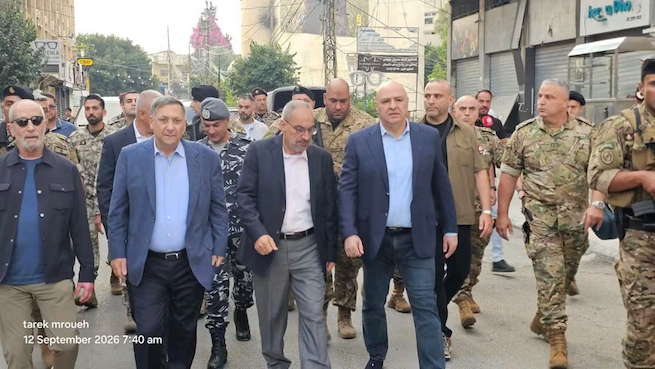
Certain Lebanese political representatives visiting Washington have reportedly been circulating a narrative among officials at the State Department, the Treasury and influential think tanks that the Commander of the Lebanese Armed Forces is either incapable of confronting Hezbollah or unwilling to do so. Implicit in this narrative is an indictment of the President of the Republic for having appointed him.
This argument is as intellectually dishonest as it is politically opportunistic.
Lebanon’s modern history demonstrates that the Lebanese Army cannot confront an armed faction rooted in a particular community without meaningful political support from within that community itself.
When General Michel Aoun confronted the Lebanese Forces in 1990, he enjoyed substantial support within the Christian community. When the Lebanese Army confronted extremist Islamist groups in northern Lebanon, it benefited from the backing of the Sunni prime minister and significant segments of the Sunni political and religious establishment.
The same reality applies today. No military commander can reasonably be expected to undertake a confrontation with Hezbollah without meaningful support from within the Shiite community, including Amal and independent Shiite political and civic figures.
The issue is not one of military capability, courage or determination. It is one of national cohesion and political legitimacy. Without such a consensus, an effort to establish the exclusive authority of the State risks degenerating into a sectarian conflict, undermining the very institution entrusted with preserving national unity.
Those who travel to Washington to question the competence or resolve of the Army Commander know this reality perfectly well. Yet, rather than working towards the political consensus necessary to restore the State’s sovereignty, they appear more interested in undermining the President and the military leadership.
Their apparent objective is to position themselves as Washington’s indispensable interlocutors in Lebanon and as the only credible political alternative to the country’s constitutional leadership.
They are neither.
Lebanon does not need politicians who export its divisions to foreign capitals for personal or partisan advantage. It needs leaders capable of building the domestic consensus necessary to restore the authority of the State over its entire territory.
The Army’s responsibility is to defend the Republic. The politicians’ responsibility is to create the conditions that allow it to do so. Those who fail in the latter have no standing to lecture the Army on the former.
It’s absolutely insane to undermine what little we have by masquerading dissent in Washington DC wearing Four Season’s slippers, on the way down to the Spa. Having said that he should stop broadcasting live his internal communication inside LAF command. We don’t need and don’t want to know. What the public must know however is a list of conditions that would if gathered give the army the capacity it need. Our allies neeed to know, their Congress needs to know, the Lebanese public and the government needs to know.