


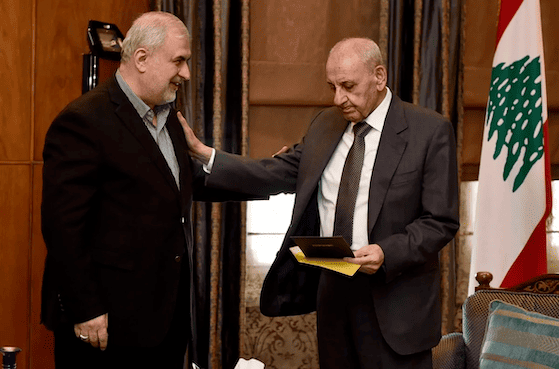
As Hezbollah faces mounting judicial and security pressure, Nabih Berri’s political machinery appears to be reviving a familiar strategy: weaponising economic hardship to pressure the Lebanese state into conceding to Hezbollah’s demands.
Two strikes in the space of three days. Two sectors essential to the functioning of the Lebanese economy. And a political establishment that knows perfectly well that the government has little financial room to meet their demands.
On Wednesday, Lebanon’s land transport unions, headed by Bassam Tleiss, a senior official within the Amal Movement, took to the streets demanding financial assistance to compensate for rising fuel costs and action against unlicensed transport operators. Major roads were partially blocked, disrupting economic activity across the country.
On Friday, public administration employees are scheduled to strike across government ministries and departments, demanding higher salaries and transportation allowances.
Both sectors have legitimate grievances. But given Amal’s longstanding influence within Lebanon’s trade unions and public administration, the timing of these strikes deserves closer examination.
Are we witnessing spontaneous economic protests, or the revival of an old political strategy by Hezbollah’s ally within the government to prop up the organisation at a time of mounting pressure?
The rich mobilising the poor
There is something particularly obscene about members of a political establishment that has accumulated extraordinary wealth over three decades in power mobilising the poorest segments of Lebanese society to demand a better standard of living.
The very political class that participated in bankrupting the country is now presenting itself as the defender of those impoverished by its policies.
Where were these concerns when billions of dollars were being squandered through subsidies, political patronage, inflated public contracts and decades of fiscal mismanagement?
Today, transport workers cannot afford petrol, public employees cannot survive on their salaries, and depositors cannot access their savings. Yet the political leadership that presided over this economic collapse remains largely intact.
The richest people in the country are sending the poorest into the streets to demand money from a state they helped bankrupt.
Who is supposed to pay?
Lebanon’s problem today is not simply one of inadequate wages. It is the absence of sustainable financing and liquidity.
The government has defaulted on its sovereign debt, the banking system remains paralysed, and the central bank cannot continue financing government expenditure as it did before 2019.
The leadership of the Shiite duo appears unwilling to accept that the financial model that sustained its political patronage networks for decades no longer exists.
For years, Banque du Liban effectively financed the state’s inability to live within its means, ultimately at the expense of depositors. That source of funding has dried up.
In September 2026, the IMF explicitly cautioned against further salary and pension increases without corresponding revenue measures.
Any additional government expenditure must ultimately be financed through higher taxation, reductions in other expenditure, borrowing or monetary financing, with its inflationary consequences.
Where exactly do the organisers of these strikes expect the money to come from?
Blocking roads, disrupting businesses and shutting down public institutions only damages what little economic activity remains, reduces government revenues and undermines the state’s ability to meet the very demands being made.
It is economic self-sabotage.
The political pressure behind the economic demands
These strikes cannot be examined in isolation from recent developments involving Hezbollah.
The organisation is facing increasing judicial and security scrutiny over two particularly sensitive cases: the interception of a shipment of explosives in Dahr al-Baydar and the arrest of five suspected Hezbollah operatives in the mountainous region between Bsharri and Batroun, amid serious allegations concerning their activities that remain under judicial investigation.
On Wednesday, Hezbollah Secretary-General Naim Qassem demanded the release of the five detainees, suggesting that they were simply moving around their own country.
Apparently, Hezbollah has developed a rather unusual enthusiasm for hiking. Judging by its previous hiking expeditions along the Israeli border, one might forgive the Lebanese authorities for taking a particular interest in its mountain walks.
The question is whether the mobilisation of trade unions is part of a broader political effort to pressure the government and judiciary at a time when Hezbollah finds itself increasingly cornered.
The return of an old playbook
Lebanon has seen this before.
On May 7, 2008, a general labour strike demanding better living conditions and higher wages coincided with Hezbollah’s opposition to government decisions concerning its private telecommunications network and airport security.
What began under the banner of workers’ rights culminated in Hezbollah’s armed takeover of parts of Beirut.
Economic grievances provided the backdrop for what ultimately became a military and political confrontation with the Lebanese state.
On October 17, 2019, Lebanon again witnessed the enormous political leverage of street mobilisation. The proposed WhatsApp tax triggered demonstrations, road closures and widespread disruption, including in Beirut’s southern suburbs and along major transport routes.
The uprising subsequently developed into a nationwide revolt against the entire political establishment.
While the circumstances were different, both episodes demonstrated how quickly control of the streets could translate into pressure on the government.
Today, the economic circumstances are considerably worse, and Hezbollah is once again facing pressure from state institutions.
The similarities are difficult to ignore.
Nabih Berri: Hezbollah’s political oxygen
Much of the international attention remains focused on Hezbollah while considerably less attention is paid to the political infrastructure that sustains it within the Lebanese state.
At the centre of that infrastructure stands Parliament Speaker Nabih Berri.
Through Amal’s extensive influence within state institutions, public administration, trade unions and political networks, Berri possesses instruments of pressure that extend well beyond Hezbollah’s military capabilities.
It is difficult to imagine a sustained political mobilisation through Amal-affiliated networks without the knowledge of the man who heads the movement.
Hezbollah may be under military, financial and judicial pressure, but Berri continues to provide it with political protection and institutional leverage.
It is rare that Hezbollah makes a significant domestic political move without its longstanding ally.
Nabih Berri is Hezbollah’s political oxygen in Lebanon.
Those seeking to dismantle Hezbollah’s grip on the country while overlooking Berri’s role are addressing only half the problem.
Lebanon cannot rebuild its economy while its remaining economic activity is repeatedly held hostage to the political survival of those who contributed to its destruction.
The Lebanese people deserve better wages, better living conditions and a functioning economy. What they do not deserve is to have their poverty weaponised by wealthy political leaders seeking to protect their own power and the interests of an armed organisation.
Lebanon’s economic recovery cannot continue to be the price the country pays for Hezbollah’s political survival.