



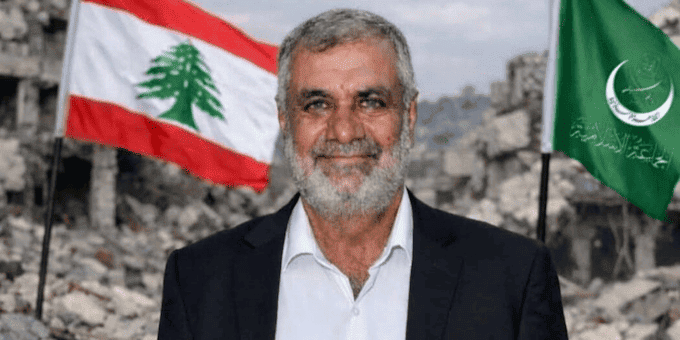
The next northern-front threat isn’t a ‘Hezbollah alternative’ – it’s an Islamist partner hiding in plain sight, built for legitimacy in peacetime and attack in war
by Jose Lev Alvarez Gomez
Israel’s northern front has a familiar terrorist brand name: Hezbollah. However, the recent IDF operation in southern Lebanon and the arrest of a senior operative from al-Jama’a al-Islamiyya should be read as a warning flare. Something else is moving in Lebanon—Sunni, Islamist, disciplined, and deliberately low-profile. Not a replacement for Hezbollah, but a complementary threat that thrives precisely because it does not demand constant attention.
Al-Jama’a al-Islamiyya is not a newcomer. It is Lebanon’s longstanding Muslim Brotherhood branch, founded in the 1960s, built patiently through mosques, charities, student networks, and political participation. Like the Brotherhood movements elsewhere, it mastered the art of legitimacy first. Elections, social services, preaching, coalition politics. All of it is designed to look “normal” in a fractured state where normalcy is already an illusion.
But the Brotherhood model is never purely civic. It is dual-use by design. As a result, Al-Jama’a maintains an armed wing, the al-Fajr Forces, kept deliberately out of sight during quiet periods and activated when conditions allow; and that moment arrived after October 7, 2023.
As Hezbollah opened fire in the north, al-Jama’a operatives launched rockets and attacks of their own, openly declaring participation in what they framed as the broader resistance campaign against Israel. This was not symbolic solidarity. It was an operational engagement.
The group’s relationship with Hamas is neither incidental nor recent. Ideologically, both sit inside the same Brotherhood universe. Operationally, coordination has been reported repeatedly since the Gaza war began. Al-Jama’a figures have publicly praised Hamas’s actions, framed their own attacks as support for Gaza, and synchronized activity along the northern front in ways that leave little doubt about shared intent. Plainly, this is not a formal merger, but it is functional alignment—the kind that matters far more than paperwork.
As for the Palestinian Islamic Jihad (PIJ), the relationship is looser but still relevant. PIJ lacks the Brotherhood’s social infrastructure but excels at kinetic action. In southern Lebanon, where militant ecosystems overlap, the distinction between cooperation and coexistence often blurs. Shared launch areas, overlapping logistics, and parallel objectives create de facto coordination even when chains of command remain separate. In Lebanon’s south, terrorist groups do not need formal alliances to function as a single pressure system against Israel.
Thence, what makes al-Jama’a dangerous is not its size; recent estimates of its membership are modest by Lebanese standards. What matters is placement.
Strategically, al-Jama’a is embedded among the Sunni communities that Hezbollah does not fully control. It operates politically in a state addicted to ambiguity. It offers Lebanon’s power brokers something useful: plausible deniability. When rockets fly, blame can be diffused. When Israel responds, responsibility dissolves into Lebanon’s institutional fog.
Simultaneously, funding follows the familiar Islamist pattern. There is no single, clean state sponsor comparable to Iran’s backing of Hezbollah. Instead, al-Jama’a draws on a mix of private donations, charitable fronts, diaspora support, and ideological networks tied to the broader Turkish-Qatari-Muslim Brotherhood ecosystem. This makes it harder to sanction, complicated to isolate, and easier to regenerate after disruption. Al-Jama’a is not a proxy army; it is a movement with terrorist optionality. And that is what makes it unique.
That is why Israel’s raid Sunday that captured a senior al-Jama’a member matters. Unmistakably, this operation signals a recognition that Lebanon’s threat matrix is no longer mono-dimensional, and that although Hezbollah remains the dominant force, it is no longer alone. Paradoxically, Sunni Islamist actors are positioning themselves as auxiliary fronts—smaller, quieter, and politically masked, but fully integrated into the anti-Israel axis when war opens.
To Lebanon’s detriment, this is catastrophic. A country that already struggles to contain one armed non-state actor is now normalizing a second. On top of that, Lebanese Shiite and Sunni terrorist entities are no longer rivals; they are increasingly interoperable. Different flags, different rhetoric, same strategic effect: Lebanon is being used as a launchpad without accountability.
In my assessment, the lesson is simple and uncomfortable. The next escalation may not begin with a Hezbollah speech or an Iranian signal. It may come from a group long described as “political,” “social,” or “moderate”—until the moment it decides not to be.
The Sunni front was never quiet. It was just waiting. Period.