



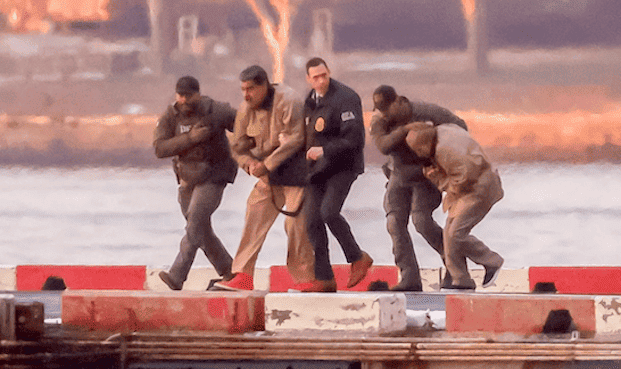
The forcible seizure of Venezuelan President Nicolás Maduro by the United States did not merely shock Latin America. It exposed, with unusual clarity, a defining feature of the current international moment: the steady replacement of rules by transactions, of institutional restraint by personal calculation. The episode did not destroy the world order. As several analysts have noted, that order had already been hollowed out. But it did confirm something more unsettling for small and medium-sized actors: under Donald Trump, American power is not anchored in predictability. It is anchored in interest.
This reality matters profoundly for Ukraine, which depends on sustained U.S. engagement to deter Russian revisionism. It matters just as much for Cyprus, where external guarantees, regional alliances and diplomatic signals interact directly with the prospects of reunification. In both cases, the central question is no longer whether Washington is strong enough to shape outcomes. It is whether Washington can be relied upon to do so consistently, or whether today’s support can become tomorrow’s bargaining chip.
Strategic contradiction and the Cyprus dilemma
An article published in eulive.net on Jan 6 is particularly striking in this regard. Written by Dionysis Dionysiou, the director of Politis and one of the most influential voices in Greek Cypriot journalism, it carries a clear warning against a growing strategic contradiction. The Greek Cypriot-run Cyprus Republic leadership maintains that all its actions serve the “supreme priority” of resolving the Cyprus problem. Yet, at the same time, defence-related messaging within the Greece–Cyprus–Israel trilateral framework is increasingly liable to be interpreted as the construction of a confrontation-oriented posture vis-à-vis Türkiye.
Dionysiou’s argument is neither anti-Israel nor dismissive of Cyprus’s legitimate security concerns. On the contrary, he acknowledges Israel’s technological edge, intelligence capacity and growing weight in Eastern Mediterranean geopolitics. Cooperation, he argues, can be a force multiplier. The danger lies not in cooperation itself but in the strategic frame within which it is pursued.
When Greek Cypriot foreign and defence policy becomes entangled in the broader Israel–Türkiye confrontation, shaped by Gaza and Syria rather than by the Cyprus problem itself, Nicosia risks paying the price of tensions that do not directly concern it. Defence initiatives that may appear rational in isolation, such as discussions about advanced air defence systems or intensified military coordination, can be reinterpreted by Ankara as part of a wider encirclement logic. In doing so, the focus shifts away from Turkish military presence, political equality and UN parameters, and toward regional power balances in which Greek Cypriots have limited control.
Perhaps most importantly, Dionysiou poses a question that cuts through much of the rhetoric: In the event of a serious military incident, would Israel intervene on Cyprus’s behalf? His answer is blunt. No. Deterrence that lacks credibility does not deter. It provokes. And once provocation replaces diplomacy, the already narrow space for a negotiated settlement shrinks further.
This warning matters because, from both Greek Cypriot and Turkish perspectives, the island’s strongest diplomatic asset has never been military alignment. It has been legitimacy. For the Greek Cypriot side, this rests on its recognition as an EU member state seeking to resolve an unresolved conflict within the framework of United Nations resolutions. From the Turkish and Turkish Cypriot perspective, however, that legitimacy is inherently incomplete. The 1960 constitutional order was in effect a federal partnership between two politically equal communities, and that system collapsed when Greek Cypriots unilaterally took control of the state institutions and forced Turkish Cypriots out of government. As a result, the all-Greek Cypriot administration cannot credibly claim to represent the entire island on its own. When the centre of gravity shifts away from Brussels and New York toward regional security alignments and military signalling, this already contested legitimacy risks further erosion, reinforcing arguments that the Cyprus problem has moved from a question of law and political equality to one of power and confrontation.
Transactional Washington and the illusion of permanence
It is against this backdrop that the question of confidence in Trump’s United States becomes unavoidable. The Maduro operation illustrated how rapidly Washington can redefine legal and political boundaries when domestic messaging and strategic gain coincide. The justifications offered were narrow, selective and largely unconcerned with the broader precedents they set.
For allies and partners, this is not an abstract debate about international law. It is a practical lesson in volatility. Commitments are no longer primarily institutional. They are personal, situational and reversible.
Even the diplomatic process itself now reflects this shift. The recent Ukraine talks held in Paris were handled not through established institutional frameworks but by figures closely associated with the White House, notably Steve Witkoff and Jared Kushner. Such personal channels can accelerate deals. They can also be reversed with equal speed when political calculations change.
It would also be prudent to underline how rapidly American attitudes can shift depending on Washington’s immediate interests. In this context, Türkiye occupies a fundamentally different position from the Greek Cypriot-run Cyprus Republic. Regardless of how intensively the Greek lobby operates on Capitol Hill, or how attractive the political and strategic offers made by the Christodoulides administration or Athens may appear, Türkiye remains a country that the United States cannot easily marginalise when broader imperial and strategic calculations come into play.
Despite periods of tension and divergence, the personal, leader-to-leader relationship between Donald Trump and Turkish President Recep Tayyip Erdoğan is an established and visible factor in bilateral dynamics. Overreliance on U.S. backing, combined with sustained efforts to push Türkiye into a perception of strategic encirclement, carries serious risks. In the end, such an approach may prove far more costly than anticipated, particularly if Washington recalibrates its priorities and opts for accommodation rather than confrontation.
This is not speculation. It is the logic of transactional power. The same Washington that today deepens security cooperation with Republic of Cyprus could tomorrow seek a broader understanding with Ankara if that better serves U.S. interests in NATO, the Black Sea, the Middle East or great-power competition.
Ukraine and the limits of American guarantees
Ukraine’s predicament exposes the same structural problem in a far more acute form. Since Russia’s invasion, Kyiv has relied heavily on U.S. military, financial and diplomatic support. Under Trump, efforts to push toward a negotiated settlement have intensified, but not without friction. European leaders have already signalled discomfort with aspects of U.S. peace proposals, stressing that any agreement must respect the core principle that borders cannot be changed by force.
At the same time, Washington has floated ideas of “Article 5–like” security guarantees for Ukraine, a formulation that sounds reassuring but raises immediate questions about enforceability. Guarantees deter only if they are credible, and credibility rests on the willingness to absorb costs when commitments are tested.
Here again, the Venezuela episode casts a long shadow. It reinforces the perception that U.S. policy is increasingly shaped by domestic narratives and tactical advantage rather than by consistent normative frameworks. That perception matters not only for Kyiv but also for Moscow, which has long justified its actions by pointing to Western precedents. Each additional erosion of legal restraint strengthens the argument that power, not principle, is the ultimate arbiter.
Ukraine thus faces a dual risk. First, that guarantees may be framed in ways that allow future reinterpretation or dilution. Second, that the broader normative environment necessary to sustain international pressure on Russia continues to erode, particularly in parts of the Global South already sceptical of Western double standards.
Confidence without illusions
So how much confidence can Cyprus or Ukraine reasonably place in Trump’s USA? The honest answer is neither zero nor absolute. The United States remains the most consequential external actor in both theatres. Its capabilities are unmatched. When Washington decides to act decisively, outcomes follow. But confidence must be recalibrated. It cannot be based on assumptions of permanence or moral consistency.
For the Greek Cypriots, this means resisting the temptation to substitute external military alignments for the hard, patient work of building a settlement logic. Anchoring the Cyprus problem firmly within the EU and UN framework, lowering the temperature with Türkiye and avoiding the illusion of deterrence through confrontation are not signs of weakness. They are expressions of strategic sobriety.
For Ukraine, it means embedding any U.S. guarantees within broader European and multinational structures that raise the political cost of reversal. Redundancy, not dependence, is the only viable hedge against volatility.
Trump’s America can deliver deals. It can apply pressure. It can even impose order, temporarily. What it does not offer is predictability. In a world where interests are renegotiated rapidly and personal relationships outweigh institutional memory, confidence must be disciplined, conditional and constantly reassessed.
For those who mistake American power for American permanence, the cost of miscalculation may prove far higher than anticipated.