



The ambassador’s missteps reflect a poor grasp of the region’s complex dynamics and jeopardize opportunities for peace
President Trump’s unscripted statements are a hallmark of his leadership. While this unpredictability often unsettles America’s allies, it keeps adversaries on edge, contributing to his widespread popularity at home. However, this approach, effective for the president, is ill-suited for his envoys – especially in the volatile Middle East, where history, vendettas, and cultural sensitivities amplify the weight of every word.
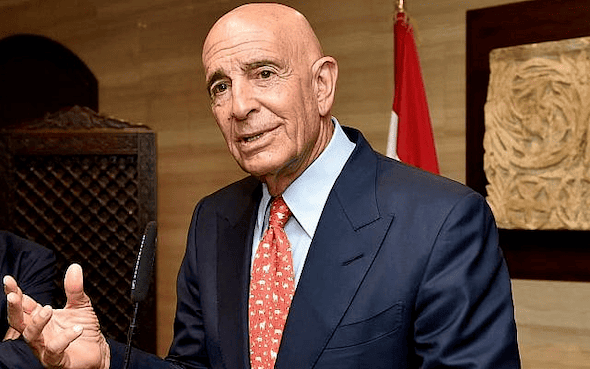
Over the past week, US Ambassador to Turkey and Envoy to Syria Tom Barrack has made several statements that diverged from Washington’s official policy, raising eyebrows across the Middle East. His remarks have frequently been contradicted by the State Department or required him to backtrack.
In pursuit of President Trump’s goal of fostering peace in the Middle East, particularly between Israel and its Arab neighbors, Barrack brings a deal-making mindset from his real estate investment background. This outside-the-box thinking is an asset, but only if he understands the region’s complex dynamics – a clear blind spot in his diplomacy.
Barrack’s strategy appears straightforward: Grant incumbent rulers their demands in exchange for normalizing ties with Israel and aligning with the US-led coalition against China, Russia, and Iran. The challenge, however, lies in the deep-seated rivalries among the governments he seeks to court, which are marked by a long history of wars and grudges.
Barrack’s missteps began with his criticism of the Sykes-Picot Agreement, the 1916 British-French accord that shaped the modern borders of Lebanon, Syria, Iraq, Jordan, and Israel.
Denouncing Sykes-Picot aligns Barrack with groups that reject the nationhood of these states. Radical Arab nationalist movements, like the Baath Party, have long sought to erase these borders to create a pan-Arab nation “from the Atlantic Ocean to the Arabian Gulf.” Similarly, ISIS aimed to dismantle these nation-states in favor of a centralized Islamic Caliphate. By echoing this rhetoric, Barrack inadvertently appeared to challenge the nation-state system central to the global order America helped establish after World War II.
When minorities, such as the Kurds of Syria and Iraq, expressed enthusiasm for redrawing borders to create their own independent state, Barrack contradicted himself. He insisted that Syria must remain a centralized state with “one country, one nation, one military,” arguing that federalism does not work.
Yet, Kurds and other Syrian minorities, including Assyrians, Turkmen, and Armenians, have not demanded partition but rather decentralization. They seek relief from a Syrian state that, under President Ahmad Sharaa, continues to define itself as an Arab republic, marginalizing non-Arab ethnicities. Sharaa’s constitution retains provisions from the Assad era, declaring Islam the primary source of legislation and requiring the president to be Muslim, effectively barring non-Muslims from the country’s highest office.
Washington and its European allies have long urged Sharaa to decentralize power to address these concerns. Barrack’s apparent endorsement of Sharaa’s centralized vision, at the expense of non-Arab and non-Muslim Syrians, suggests a lack of awareness of these nuances.
Barrack’s errors were compounded in Lebanon, where he endorsed Beirut’s justifications for not disarming Hezbollah. “Hezbollah is a political party and it also has a militant aspect to it,” he said, prompting the State Department to swiftly reaffirm its longstanding position that it does not distinguish between Hezbollah’s political and military wings. Hezbollah’s leader, Naim Qassem, further undermined Barrack’s claim by denying any such dichotomy within the organization.
Barrack also accepted Beirut’s argument that disarming Hezbollah could spark civil war and should therefore be a gradual process – diplomatic code for indefinite delay – achieved through dialogue to develop a “national defense strategy.”
While seemingly accommodating Lebanon’s stance, Barrack simultaneously warned that failure to disarm Hezbollah’s “heavy and medium” weapons would leave Lebanon isolated as the region moves toward peace and prosperity. He even suggested that Sharaa might consider annexing Lebanon, noting that Syrians view their smaller neighbor as a “summer resort” and part of the broader Levant, Bilad al-Sham in Arabic.
Hezbollah seized on this statement, portraying it as evidence of a US-Israeli plot to hand Lebanon over to Sunni Islamist Sharaa. This narrative alarms Lebanon’s Shia and Christian communities, positioning a heavily armed Shia Islamist Hezbollah as their defender against a perceived Sunni Islamist takeover.
Barrack later attempted to clarify his remarks in a post on X, claiming he meant something else, but the damage was done. His unscripted approach risks further missteps that could jeopardize the rare opportunity to normalize ties between Israel and its neighbors, Syria and Lebanon.
To seize this rare opportunity, Barrack must align his statements with Washington’s carefully crafted policies and grasp the Middle East’s intricate dynamics. Seasoned Washington experts, well-versed in the region, wish him success in his peace efforts. When his understanding falls short, he should seek their expertise and guidance.
Hussain Abdul-Hussain is a research fellow at the Foundation for the Defense of Democracies (FDD)