



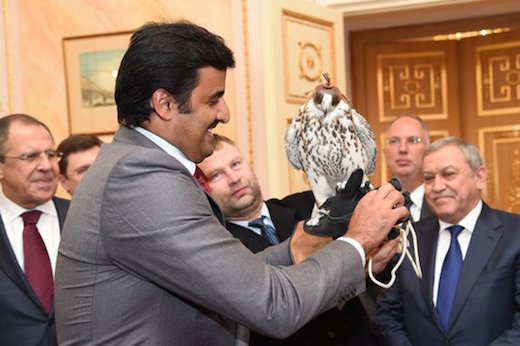
Vladimir Putin gives Sheikh Tamim a falcom
A Qatari decision to backtrack on minimal improvements of the terms of employment of migrant workers, who account for a majority of the Gulf state’s population, and a Qatari investment in Russian oil company Rosneft PJSC, symbolize the emergence of a new global power structure with the rise of populists in the United States and Europe, and Russia projecting itself as a key player on the world stage.
The message is that countries like Qatar that has been under pressure to clean up its human rights act in the wake of winning hosting rights for the 2022 World Cup no longer feel the need to at least pay lip service to human rights and trade union activists clamouring for an end to kafala, the labour sponsorship system that puts employees at the mercy of their employers.
Similarly, the Qatar Investment Authority’s decision to invest $5 billion in Rosneft as part of a $10.6 billion deal that also involved Glencore Plc had as much to do with geopolitics as with economics. Qatar saw the investment as a way to strengthen political links with Russia as well as develop new business opportunities.
The deal was remarkable for a country that uses investment as a tool to forge relations. Russia and Qatar have not been the closest of friends. Russia suspects Qatar of supporting militant Islamist and jihadist groups in Syria and of having done so earlier in Chechnya when Russia was battling Chechen Islamists there. Russian agents in 2004 assassinated Chechen rebel leader Zelimkhan Yandarbiyev in the Qatari capital of Doha.
A statement after a recent phone call between Russian President Vladimir Putin and Qatari emir Tamim bin Hamad Al Thani as Russian warplanes bombarded Aleppo said the two leaders had discussed ways to “further promote political, trade, economic and humanitarian cooperation.” The statement made no mention of Syria.
All of this is not to say that Qatar is switching allegiances. Dealing with Russia is hedging its bets in recognition of the bear’s rise and the rise of populists in the West willing to deal with Russia. At the same time, Qatar has said it is committed to investing more than $35 billion in the US over the next five years, including $10 billion in infrastructure. “A significant part of Qatar’s economic portfolio is its robust relationship with the United States,” said Qatari businessman Muhammad Al Misned in a Forbes magazine op-ed.
Qatar’s hedging of its bets comes as it together with other backers of Syrian rebels opposed to President Bashar al-Assad suffered severe setbacks because of Russian backing for the Syrian leader and the fall of Aleppo, the rebels’ last urban stronghold. The Russian-backed Syrian advances have left Qatar, Turkey and Saudi Arabia with few good options to shape the battlefield by funding and arming the rebels.
The rise of Russia and the populists appears to have emboldened Qatar to backtrack on pledges it made to reform, if not eliminate the kafala system in response to pressure from human rights and trade union activists using the Guf state’s World Cup hosting rights as leverage. In a move that has undermined whatever confidence existed in Qatar’s sincerity and willingness to work with its critics, Tamim backtracked on the easing of exit visa restrictions for migrant workers two weeks after a long-heralded law was enacted making changes to the controversial system.
The law introduced an automated system operated by the interior ministry to streamline exit visas and remove the power of employers by taking away from them the right to decide whether a worker could leave the country or not. Tamim overruled the law in early January by stipulating that workers would have to inform their recruiter.
In response, Human Rights Watch charged that “changes to the labour law that took effect in 2016 will not protect migrant workers from the serious abuses that characterize Qatar’s construction industry and other low-paid sectors of its economy… Migrant workers will not be able to switch employers, even if the workers experience abuse, and will still need their employer’s permission to leave the country.”
Qatar’s backtracking followed a victory in a Swiss court by world soccer body FIFA that has direct impact on the debate over the Gulf state’s labour regime. The court rejected a request by the Netherlands Trade Union Confederation (FNV) and two Bangladeshi unions that it rule against FIFA’s awarding of the World Cup to Qatar without first demanding assurances about “fundamental human and labour rights of migrant construction workers, including the abolition of the kafala system.”
The court decision coupled with the rise of populists who have less concern for human rights is likely to diminish FIFA’s already weak resolve to pressure Qatar to fundamentally reform if not abolish kafala. FIFA president Gianni Infantino nonetheless insisted last month that “we will put pressure, we will continue to do that.”
The turning tide could prompt activists to attempt to step up pressure on Qatar with calls for boycotts. The Washington-based Alliance for Workers Against Repression Everywhere (AWARE) said last month that it was stepping up efforts to persuade travellers from Boston and other US cities to avoid flying on Qatar’s state-owned airline because of what it alleges are human rights violations by Qatar as well as Qatar Airways. AWARE has used billboard ads in US cities serviced by Qatar Airways, op-ed pieces and social media to urge travellers to boycott the airline.
Dr. James M. Dorsey is a senior fellow at the S. Rajaratnam School of International Studies, co-director of the University of Würzburg’s Institute for Fan Culture, and the author of The Turbulent World of Middle East Soccer blog, a recently published book with the same title, and also just published Comparative Political Transitions between Southeast Asia and the Middle East and North Africa, co-authored with Dr. Teresita Cruz-Del Rosario.