
Close Menu
    Facebook Instagram LinkedIn
    • العربية (Arabic)
    • English
    • Français (French)
    Facebook Instagram LinkedIn
    Middle East Transparent
    • Home
    • Categories
      1. Headlines
      2. Features
      3. Commentary
      4. Magazine
      5. Cash economy
      Featured
      Headlines Khalil Youssef Beidas

      The Panic Seeps to Dodge City

      Recent
      25 January 2026

      Federalism Is the Only Shield Lebanon and Iraq Have Left in a Nuclearizing Middle East

      25 January 2026

      The Panic Seeps to Dodge City

      23 January 2026

      Inside the Bank Audi Play: How Public Money Became Private Profit

    • Contact us
    • Archives
    • Subscribe
    • العربية (Arabic)
    • English
    • Français (French)
    Middle East Transparent
    You are at:Home»Categories»Features»Google Earth Is Helping Syrians Call In US Air Strikes

    Google Earth Is Helping Syrians Call In US Air Strikes

    0
    By Defense One on 12 August 2015 Features

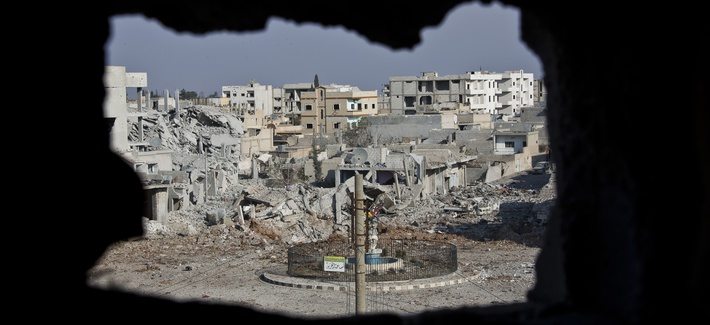
    Kurdish militia fighters are using Android tablets and free Google mapping tools to track battle lines and coordinate close air support with the US military.

     By Tim Fernholz

    Google—or the many products and services now under the holding company Alphabet—provides the connecting tissue between U.S. forces and Kurdish militias fighting against ISIS in war-torn Syria.Subscribe to Defense One Today.

    New York Times reporter Rukmini Callimachi writes from the battlefield that fighters are using Android-powered Samsung tablets and Google Earth to track their battle lines and coordinate close air support with the U.S. military:

    “Our comrades can see the enemy moving at the GPS address I just sent you,” [a Kurdish fighter]wrote in Arabic to a handler hundreds of miles away in a United States military operations room. Then he waited for the American warplanes to scream in. The strike that ensued soon after blasted a crater at exactly the coordinates provided by the Kurdish fighter. It left a circle of bodies, including one of an Islamic State fighter who died slumped over his AK-47.

    The Times account of the conflict in Syria is focused on the political challenges of the U.S. alliance with Kurdish fighters whose separatist political agenda has earned them the enmity of other regional players, including Turkey, itself a key factor in the fight against the fanatical Islamist organization.

    But the deployment of free-to-use software developed by the American computing giant shows the changing ways of modern war. In the past, U.S. companies contributing to the war effort would publicize their patriotic efforts and act in traditional spheres of armaments production. Today, fighters use freemium software. Google did not respond to a request for comment about this use of its software, and the Defense Department declined to comment.

    Anyone who has relied on Google’s map products to drive cross-country or find friends in a park may be surprised to find the software being deployed for life and death matters—at one point, Callimachi reports that U.S. military coordinators sent a map to Kurdish fighters with a yellow circle marked out, instructing them to take refuge there while the U.S. bombed nearby ISIS targets.

    Ironically, one reason for this reliance on Google’s map database is that U.S. military satellite maps are considered too sensitive to be shared with allied fighters from non-NATO countries, an obstacle characteristic of the troubled U.S. efforts to back local militias. U.S. soldiers reportedly resorted to Google Earth to help fill that gap, and one defense contractor has developed an app called iSpatial that relies on Google’s maps API to provide information to the American soldiers and diplomats.

    Use of Google Earth is also likely to mean a smaller footprint for U.S. forces on the ground. Conducting air strikes near ground troops is a delicate military operation for obvious reasons, and in the past, might have required U.S. forward observers on the ground to pick targets or to train fighters to do so. But with a globally popular operating system and app like those developed by Google, the Kurds can now just send the GPS coordinates to the cloud, then watch the hot metal rain down.

    Defense One

    Share. Facebook Twitter LinkedIn Email WhatsApp Copy Link
    Previous ArticleFailed Iranian bomb attack against Komala headquarters in Sulaymaniyah
    Next Article The New Great Game: How Regional Powers Are Carving Up Syria
    Subscribe
    Notify of
    guest
    guest
    0 Comments
    Newest
    Oldest Most Voted
    Inline Feedbacks
    View all comments
    RSS Recent post in french
    • Au Liban, des transactions immobilières de l’OLP suscitent des questions 18 January 2026 L'Orient Le Jour
    • Pourquoi la pomme de la tyrannie tombe-t-elle toujours ? 10 January 2026 Walid Sinno
    • La liberté comme dette — et comme devoir trahi par les gouvernants 2 January 2026 Walid Sinno
    • La « Gap Law »: pourquoi la précipitation, et pourquoi les Français ? 30 December 2025 Pierre-Étienne Renaudin
    • Au Liban, une réforme cruciale pour sortir enfin de la crise 23 December 2025 Sibylle Rizk
    RSS Recent post in arabic
    • لِشهرين أم لِسنتين: الانتخابات النيابية مؤجّلة حُكماً! 25 January 2026 كمال ريشا
    • ثرثرة على ضفة الحركة (2): “الفلسطينيّة” و”العربيّة” 25 January 2026 هشام دبسي
    • الهَلَع يتسرَّب إلى دودج سيتي 25 January 2026 خليل يوسف بيدس
    • قضية “بنك عودة”: كيف تحوّلت الأموال العامة إلى أرباح خاصة 24 January 2026 سمارة القزّي
    • حوارٌ ضروري حول قبرص، والأمن، ونصف القصة الغائب 24 January 2026 يوسف كانلي
    26 February 2011

    Metransparent Preliminary Black List of Qaddafi’s Financial Aides Outside Libya

    6 December 2008

    Interview with Prof Hafiz Mohammad Saeed

    7 July 2009

    The messy state of the Hindu temples in Pakistan

    27 July 2009

    Sayed Mahmoud El Qemany Apeal to the World Conscience

    8 March 2022

    Russian Orthodox priests call for immediate end to war in Ukraine

    Recent Comments
    • Nadim Shehadi on The Panic Seeps to Dodge City
    • Yusuf Kanli on A necessary conversation: On Cyprus, security, and the missing half of the story
    • Mohamed on Inside the Bank Audi Play: How Public Money Became Private Profit
    • JudgmentalOne on A necessary conversation: On Cyprus, security, and the missing half of the story
    • Drivers Behind Audi’s Top-Level Management Shake-Up - Middle East Transparent on Lebanon’s banks are running out of excuses
    Donate
    © 2026 Middle East Transparent

    Type above and press Enter to search. Press Esc to cancel.

    wpDiscuz