



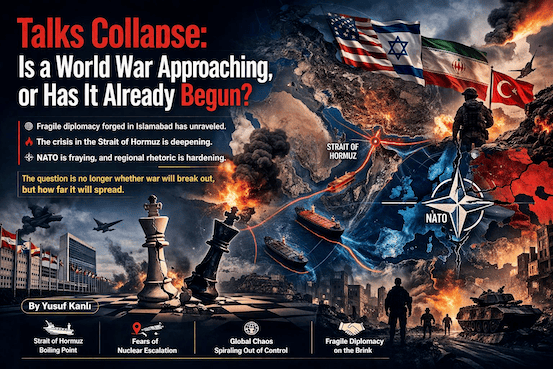
Fragile diplomacy forged in Islamabad has unraveled. The crisis in the Strait of Hormuz is deepening, NATO is fraying, and regional rhetoric is hardening. The question is no longer whether war will break out, but how far it will spread.
َAnkara- Shaffaf Exclusive
The convergence of Israeli and American policies is pushing the world toward an increasingly perilous impasse. The actions and rhetoric of Donald Trump and Benjamin Netanyahu have moved beyond calibrated deterrence into a realm of unchecked escalation. Even during a nominal ceasefire, continued strikes on Lebanon signal not restraint, but a dangerous normalization of perpetual conflict. Trump’s threats of a blockade in the Strait of Hormuz and his use of negotiation as an instrument of coercion, coupled with Netanyahu’s expansion of military operations rather than their containment and his pointed warnings toward Türkiye, are placing already fragile regional balances under extraordinary strain. The Middle East once again stands at one of the most dangerous thresholds in its modern history.
The two-week ceasefire announced after marathon talks in Islamabad was initially presented as a pause for diplomacy. In reality, it is little more than a tactical intermission. This is not a resolution, but a recalibration. None of the parties has stepped back; they have merely repositioned. To understand the current moment, one must move beyond the comforting language of “peace processes” and confront a harsher truth: what we are witnessing is not peace deferred, but war suspended.
Why diplomacy failed: Different realities at the same table
The collapse of the Islamabad talks was not a technical failure but a structural one. It is insufficient to say that the parties failed to agree; in truth, they failed to define the problem in the same terms. Washington’s 15-point proposal sought not only to dismantle Iran’s nuclear program but also to curtail its regional influence. Tehran’s 10-point framework, by contrast, was anchored in sovereignty, security guarantees, and the lifting of sanctions.
This was not a negotiable gap but a strategic chasm. Iran’s accusation of “double standards” only deepened the divide. Tehran found it unacceptable that the damage inflicted since late February would go uncompensated and that no credible long-term security guarantees were offered. Washington, meanwhile, viewed such demands as rewarding Iran without altering its regional conduct.
What emerged was not an agreement but, as diplomats described it, a “temporary bridge built on mistrust.” That bridge has now collapsed.
Strait of Hormuz: Is the war moving to the sea?
With diplomacy faltering, attention has shifted decisively to the Strait of Hormuz, a narrow passage through which roughly one-fifth of the world’s oil supply flows. Yet the issue at stake is no longer merely energy security; it is the militarization of maritime space.
If Washington proceeds with its threat to block vessels bound for Iran, and Beijing responds by escorting Iranian oil shipments with its naval forces, the implications would extend far beyond an energy crisis. Such a development would mark the direct confrontation of major powers at sea. Hormuz would cease to be a chokepoint of commerce and become a flashpoint of strategic rivalry.
In such an environment, the margin for error shrinks dramatically. A miscalculation, a radar misreading, or even a “warning shot” could trigger a cascading conflict. The debate over control of Hormuz would not merely expand the geography of war; it would fundamentally alter its character.
The analogy with the Cuban Missile Crisis is instructive. Then, a bilateral superpower standoff brought the world to the nuclear brink. Today, the risk is multiplied by the number of actors involved. This is not a bipolar confrontation but a far more intricate and volatile configuration.
The land war scenario: The point of no return
Statements from Washington suggesting that a ground operation “may not be necessary” paradoxically underscore that such an option remains on the table. In a country as vast, mountainous, and populous as Iran, any land operation would quickly transcend the limits of a short-term intervention and evolve into a protracted conflict.
Yet the risk is no longer confined to conventional warfare. A more troubling dimension is emerging: the potential crossing of the nuclear and broader NBC threshold, encompassing nuclear, biological, and chemical weapons.
The discourse surrounding Iran’s nuclear capacity is deeply entangled with questions of double standards. It is widely acknowledged in international circles that Israel possesses a significant nuclear arsenal, even if it remains officially undeclared. The United States, for its part, remains the only country to have used nuclear weapons in war, and to have done so against civilian populations.
This reality complicates contemporary narratives of “nuclear threat.” When one actor’s arsenal is framed as deterrence while another’s potential capability is cast as an existential danger, the issue ceases to be purely about security. It becomes a matter of power, perception, and political choice.
The question, therefore, is unavoidable: will the increasingly hardened posture along the Netanyahu–Trump axis remain within the bounds of conventional warfare, or could it push toward a far more dangerous threshold? An escalation to the level of NBC warfare may still appear unlikely, but it can no longer be dismissed outright. That, in itself, constitutes a serious and legitimate concern.
Such escalation is not driven solely by military calculations. It is also shaped by psychology, perception, and the logic of deterrence. As positions harden, any retreat risks being interpreted as political weakness. Once that psychological threshold is crossed, crises enter their most perilous phase.
In such a scenario, every move reverberates beyond Iran, affecting a broad arc from Iraq to Lebanon. Proxy conflicts converge into a single theater. The boundaries of war expand, control diminishes, and costs escalate exponentially.
NATO under strain: alliance or fragmentation?
One of the most striking dimensions of the current crisis is the deepening divide within NATO. The reluctance of major European powers to align fully with Washington’s military posture raises fundamental questions about the alliance’s cohesion and purpose.
Germany and France, mindful of the economic and security implications for Europe, have adopted a cautious stance, while Eastern European members, shaped by different threat perceptions, remain closer to the United States. This divergence calls into question whether NATO still possesses a unified strategic vision.
Increasingly, the prospect of a two-tier alliance is being discussed: On one side, a flexible, U.S.-led “coalition of the willing”; on the other, a more constrained European defense framework. This is not merely a military adjustment but a potential political reconfiguration of the transatlantic order.
Türkiye’s balancing act under pressure
Within this complex landscape, Türkiye occupies a uniquely delicate position. As a NATO member and a regional power with economic and geographic ties to Iran, Ankara is compelled to navigate a multidimensional balancing act.
Its mediation efforts are not simply diplomatic initiatives but strategic necessities. A deeper crisis would carry direct economic and security consequences for Türkiye. Yet the intensification of regional rhetoric is narrowing its room for maneuver, making equilibrium increasingly difficult to sustain.
The war of words: The Netanyahu–Erdoğan line
The escalating exchange of rhetoric between Benjamin Netanyahu and Recep Tayyip Erdoğan reflects more than personal or political tension; it signals a deeper strategic divergence. Israel’s framing of Türkiye as a potential disruptor and Ankara’s increasingly direct and forceful criticism of Netanyahu’s government indicate a rapid contraction of diplomatic space.
The use by Türkiye’s Foreign Ministry and Communications Directorate of the phrase “Hitler of our time” to describe Netanyahu underscores the extent to which Ankara’s patience has eroded and how far it has moved beyond conventional diplomatic language. This is not merely criticism; it is a moral and historical positioning that places Israel’s actions under intense scrutiny.
Foreign Minister Hakan Fidan has further amplified this stance, issuing pointed warnings not only to Israel but also to Western actors. His remarks highlight the unsustainability of double standards and caution that current policies risk producing consequences that may soon escape control. The message is clear: the trajectory of the crisis is not only dangerous for the region but for all involved.
Yet such rhetoric carries risks. While it resonates domestically, it also narrows diplomatic channels. As bridges weaken, crisis management becomes more difficult, and the prospects for mediation diminish.
A new form of war: A global conflict without a name
At this juncture, the very concept of “world war” demands reconsideration. Contemporary conflicts are no longer confined to battlefields. Energy routes, trade corridors, financial systems, and diplomatic alignments have all become arenas of confrontation.
The more pertinent question, therefore, is not whether a world war will begin, but whether it has already begun in a form we have yet to fully recognize.
What we are witnessing is a multilayered conflict that transcends geography. Its most dangerous feature is the absence of clear beginnings and endings. War is not declared, yet its effects are pervasive.
The collapse in Islamabad is not merely the failure of a negotiation. It may well represent the erosion of the very line that once separated war from peace.
One can only hope this assessment proves wrong. Yet like many analysts, I am compelled to conclude that what has collapsed is not just a table, but the essential choice between war and peace itself. And the world, compared to the days before those talks, is moving toward a far more perilous and existentially fraught future.