
Close Menu
    Facebook Instagram LinkedIn
    • العربية (Arabic)
    • English
    • Français (French)
    Facebook Instagram LinkedIn
    Middle East Transparent
    • Home
    • Categories
      1. Headlines
      2. Features
      3. Commentary
      4. Magazine
      5. Cash economy
      Featured
      Headlines Yusuf Kanli

      Why Ankara Sees Israels’s Latest Moves As A Strategic Challenge

      Recent
      1 January 2026

      Why Ankara Sees Israels’s Latest Moves As A Strategic Challenge

      28 December 2025

      Writing Off the State’s Debt to BDL Is Not Reform — It Is Amnesty by Another Name

      27 December 2025

      Draining the Swamp, Not Chasing the Mosquitoes

    • Contact us
    • Archives
    • Subscribe
    • العربية (Arabic)
    • English
    • Français (French)
    Middle East Transparent
    You are at:Home»Categories»Features»Israelis have polarized views of Netanyahu, reflecting conflicts many see in Israeli society

    Israelis have polarized views of Netanyahu, reflecting conflicts many see in Israeli society

    0
    By Pew on 12 August 2023 Features

    BY LAURA SILVER AND SARAH AUSTIN

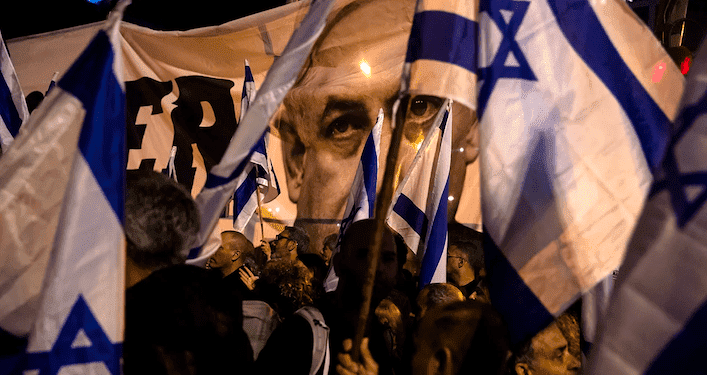
    Hundreds of thousands of people have marched in Israel in recent weeks over a controversial judicial overhaul spearheaded by Prime Minister Benjamin Netanyahu.
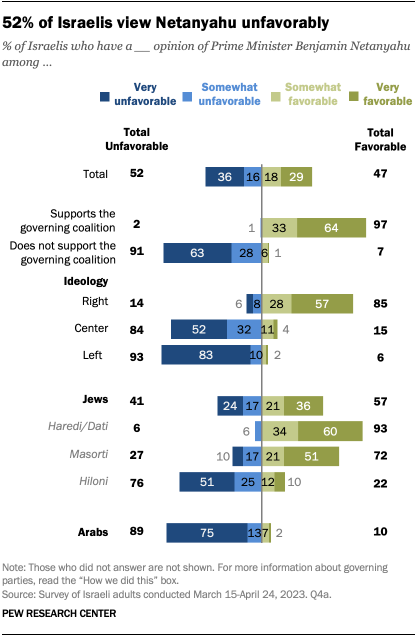
     

    A bar chart showing that 52% of Israelis view Netanyahu unfavorably.


    • A Pew Research Center survey conducted in March and April found that Israelis were divided in their views of Netanyahu and perceived a lot of political conflict in their country. The survey was conducted during a previous wave of protests against judicial reform but prior to the July passage of a law limiting the power of Israel’s Supreme Court.


    Views of Netanyahu

    On balance, Israelis viewed Netanyahu slightly more unfavorably (52%) than favorably (47%) in the spring survey, but opinions varied widely.

    People who supported Netanyahu’s conservative Likud party or other parties in his governing coalition had nearly unanimously positive views of Netanyahu: 97% said they had a favorable view of him, including 64% who had a very favorable view. But among those who did not support the governing coalition, only 7% had a favorable view of him, and 63% had a very unfavorable view.
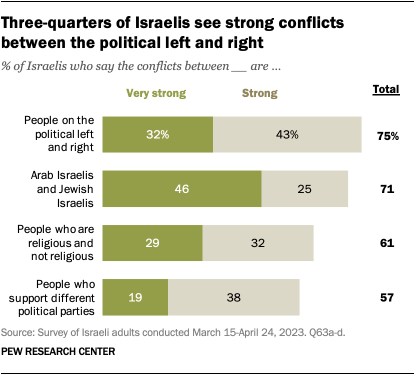
    A bar chart that shows three-quarters of Israelis see strong conflicts between the political left and right.

    Ratings were divided along ideological lines, too: 85% of people on the political right saw Netanyahu favorably, compared with 15% of those in the center and 6% on the left.

    Jewish and Arab Israelis also diverged in their views of Netanyahu: 57% of Jewish Israelis offered positive assessments, while only 10% of Arab Israelis did the same. Divisions were stark among Jews as well. While 93% of Haredi (“ultra-Orthodox”) and Dati (“religious”) Jews and 72% of Masorti (“traditional”) Jews had positive views of Netanyahu, only 22% of Hiloni (“secular”) Jews did.

    Perceived conflicts in Israeli society

    These divided views over Netanyahu reflect something most Israelis seem to agree on: that Israeli society is rife with divisions. Seven-in-ten or more Israelis saw strong conflicts between people on the political left and right, as well as between Arab and Jewish Israelis. The Arab-Jewish conflict stands out, however, because nearly half of Israelis saw it as a very strong conflict.

    Majorities also said there are strong or very strong conflicts between those who support different political parties and between those who are and are not religious.
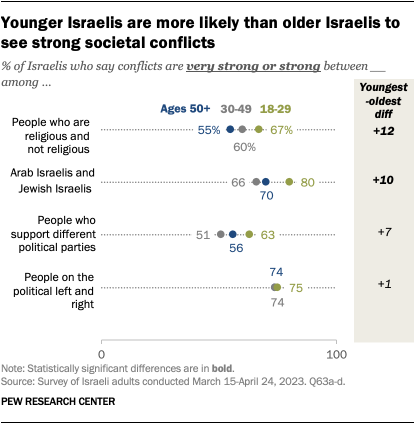
    A dot plat showing that younger Israelis are more likely than older Israelis to see strong societal conflicts.

    Younger Israelis tended to perceive most of these conflicts as more serious than older Israelis. For example, 67% of those under 30 saw strong conflicts between those who are religious and not religious, compared with 60% of those ages 30 to 49 and 55% of those 50 and older. The exception was for conflicts between the political left and right, where about three-quarters of people across age groups saw strong conflicts. But even here, younger people were more likely to see very strong conflicts.

    Arab Israelis and Jewish Israelis largely agreed on where conflicts in society lie. They were equally likely to see political or ideological strife, and around seven-in-ten in each group also saw strong conflicts between Arab and Jewish Israelis. Jewish Israelis, however, were slightly more likely than Arab Israelis (48% vs. 39%) to see very strong conflicts between Arab and Jewish Israelis.

    Among Jews, though, there were substantial differences in how likely people were to perceive conflicts between Arab and Jewish Israelis. Some 94% of Haredi/Dati Jews saw such conflicts, compared with 69% of Masorti Jews and 56% of Hiloni Jews.
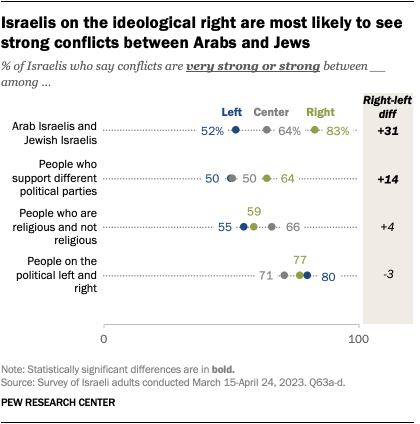
    A dot plot that shows Israelis on the ideological right are most likely to see strong conflicts between Arabs and Jews.

    Israelis on the ideological left and right agreed that there are divisions between their two poles. But those on the right (64%) were somewhat more likely than those on the left (50%) or in the center (50%) to see conflicts between people who support different political parties. Those on the right were also significantly more likely to see conflicts between Arab and Jewish Israelis.


    PEW RESEARCH CENTER

    Share. Facebook Twitter LinkedIn Email WhatsApp Copy Link
    Previous ArticleExclusive: Russia’s Spies Say Putin Faces More Coups
    Next Article Can the Lebanese Army Prevent a Hezbollah-Christian Conflict?
    Subscribe
    Notify of
    guest
    guest
    0 Comments
    Newest
    Oldest Most Voted
    Inline Feedbacks
    View all comments
    RSS Recent post in french
    • La liberté comme dette — et comme devoir trahi par les gouvernants 2 January 2026 Walid Sinno
    • La « Gap Law »: pourquoi la précipitation, et pourquoi les Français ? 30 December 2025 Pierre-Étienne Renaudin
    • Au Liban, une réforme cruciale pour sortir enfin de la crise 23 December 2025 Sibylle Rizk
    • Le Grand Hôtel Abysse sert toujours des repas en 2025 16 December 2025 Walid Sinno
    • Au cœur de Paris, l’opaque machine à cash de l’élite libanaise 5 December 2025 Clément Fayol
    RSS Recent post in arabic
    • هَلَّلتُم لاعتقال “صدام”.. فلماذا اعتقالُ مادورو “بلطجة”! 3 January 2026 فاخر السلطان
    • شخصيات إيرانية بارزة تدعو لـ”انتقال سلمي للسلطة” 3 January 2026 خاص بالشفاف
    • هل نحن في “دولة” أم في دويلات؟ 2 January 2026 وفيق هواري
    • ليبيا: انتهاك الحقوق والتمييز وجريمة اغتيال روح البحث العلمي 2 January 2026 أبو القاسم المشاي
    • انتفاضة إيران “اليوم الخامس”: تظاهرات في المدن الصغيرة و6 قتلى 1 January 2026 الشفّاف
    26 February 2011

    Metransparent Preliminary Black List of Qaddafi’s Financial Aides Outside Libya

    6 December 2008

    Interview with Prof Hafiz Mohammad Saeed

    7 July 2009

    The messy state of the Hindu temples in Pakistan

    27 July 2009

    Sayed Mahmoud El Qemany Apeal to the World Conscience

    8 March 2022

    Russian Orthodox priests call for immediate end to war in Ukraine

    Recent Comments
    • P. Akel on The Grand Hôtel Abysse Is Serving Meals in 2025
    • Rev Aso Patrick Vakporaye on Sex Talk for Muslim Women
    • Sarah Akel on The KGB’s Middle East Files: Palestinians in the service of Mother Russia
    • Andrew Campbell on The KGB’s Middle East Files: Palestinians in the service of Mother Russia
    • farouk itani on A Year Later, Lebanon Still Won’t Stand Up to Hezbollah
    Donate
    © 2026 Middle East Transparent

    Type above and press Enter to search. Press Esc to cancel.

    wpDiscuz