



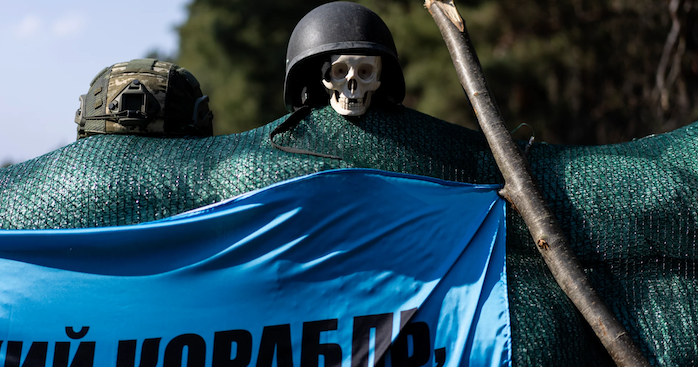
A plastic skull is displayed at a check point on the outskirts of Kyiv, Ukraine, Friday, March 25, 2022. (Credit: AP Photo/Rodrigo Abd.)
ROME – This week, the University of Notre Dame announced that Archbishop Borys Gudziak, the highest-ranking prelate of the Ukrainian Greek Catholic Church in the U.S., will deliver this year’s commencement address. No matter the circumstances, the choice would have made great sense – Gudziak is a graduate of Harvard who studied under Henri Nouwen, the founder and president of the Ukrainian Greek Catholic University in L’viv, and one of the Catholic Church’s preeminent public intellectuals.
In context, however, inviting Gudziak is also a statement of solidarity with Ukraine as Putin’s scorched-earth war grinds on mercilessly.
If a retired NYU professor of Russian history is right, the big stage for Gudziak may also help explain what Putin is doing in Ukraine in the first place.
Jane Burbank took to the New York Times on March 22 to offer a provocative reading of Putin’s motives. Forget the Tsar or the Soviet Union, Burbank provocatively argues – what Putin really wants back is no less than the Mongol Empire, with him in charge.
Historically, Burbank says, in the Russia of the 1910s and 1920s, there were two major intellectual camps regarding the country’s future after the Tsar, and both reflected deeply imperialistic ambitions.
One was the Bolsheviks and their dream of Russia leading a global workers’ struggle to usher in the classless state. The other was less well known, but influential in elite circles. It dreamt of Russia rebuilding the grand Eurasian empire of the 13th and 14th centuries, which, at its peak, included all of modern-day Mongolia, China, parts of Burma, Romania, Pakistan, Siberia, Ukraine, Belarus, Cilicia, Anatolia, Georgia, Armenia, Persia, Iraq, Central Asia, and much or all of Russia, along with additional countries as tributary states.
This Eurasian vision imagined such a modern-day empire as thoroughly rooted in the Russian Orthodox faith, thereby standing as a permanent bulwark of values and tradition against the decadent West.
That empire, according to Burbank, is the “grand theory” driving the war.
In turn, it may help explain Putin’s obsession with Ukraine, which isn’t just about the Baptism of Rus’ in 988 or reabsorbing a territory Russians have always regarded as theirs. It’s also about destroying, or at least stifling, the main source of resistance to the Eurasian vision within its own landmass, which is Ukraine’s Greek Catholic Church.
By far the largest of the 23 Eastern churches in full communion with Rome, the Ukrainian Greek Catholic Church has around 6 million members, roughly evenly split between Ukraine itself and a Ukrainian diaspora around the world. Historically it dates to the 1596 Union of Brest, which brought the Ruthenian Orthodox Church of the Polish-Lithuanian Commonwealth into union with the Vatican.
By 1963, the church was officially recognized as Ukrainian since that’s where it flourished and put down roots.
It’s not just the numbers, however. The Greek Catholic Church punches well above its weight in terms of social and cultural affairs. It helped lead the 2004-2005 “Orange Revolution,” which brought down the corrupt regime of Viktor Yanukovych in favor of the more pro-Western Viktor Yuschenko, and it has also led the moral and spiritual mobilization in opposition to the current Russian invasion.
The Greek Catholics have a noble history, having been the most martyred church in the world in percentage terms during the Soviet era. Gudziak envisioned the legacy of those martyrs as one “wing” of the re-founded Catholic University in Ukraine, described as the “only Catholic university between Poland and Japan.” (In keeping with Gudziak’s studies under Nouwen, the other wing is the disabled.)
Though one shouldn’t be too sweeping in characterizing the thinking of Greek Catholics, as they’ve got their internal contrasts and divisions just like everybody else – I mean, a small rump band of Greek Orthodox traditionalists who consecrated their own bishops without permission of the pope in 2009, actually declared the Throne of Peter vacant in 2019, staged a conclave, and elected, of all people, Italian Archbishop Carlo Maria Viganò, who’s developed a second career as a professional thorn in the side of Pope Francis.
Nonetheless, it’s safe to say that mainstream Greek Catholic thought is highly nationalistic, but not in the pugnacious, “us v. the West” sense of Russia. Instead, it envisions a truly independent Ukraine, fostering the best of its distinctive culture but deeply engaged with the international community. As part of that picture, Greek Catholic intellectuals have dreamed of Ukrainian Orthodox and Catholic believers coming together in some form of “reconciled diversity,” and thus independent of Moscow.
The Greek Catholics typically are also dubious about the Vatican’s “Russia Policy,” which, in practice, often means bending over backward to placate Moscow for the sake of some eschatological dream of reuniting the Christian East and West. As the Ukrainians tend to see it, those long-term ambitions shouldn’t justify allowing a bully to push around a local church that’s paid more than its fair share of blood for its loyalty to Rome.
There simply isn’t anyplace else in the former Mongol Empire with a Catholic church this large, this vibrant and relevant, and, from Moscow’s point of view, this threatening.
For sure, inflicting damage on the Greek Catholic Church undoubtedly isn’t the main reason Russian tanks are clogging the highways of Ukraine these days. On the other hand, from Putin’s point of view, shutting down his central spiritual and intellectual rival in his own backyard probably wouldn’t be chump change either.
Follow John Allen on Twitter: @JohnLAllenJr