



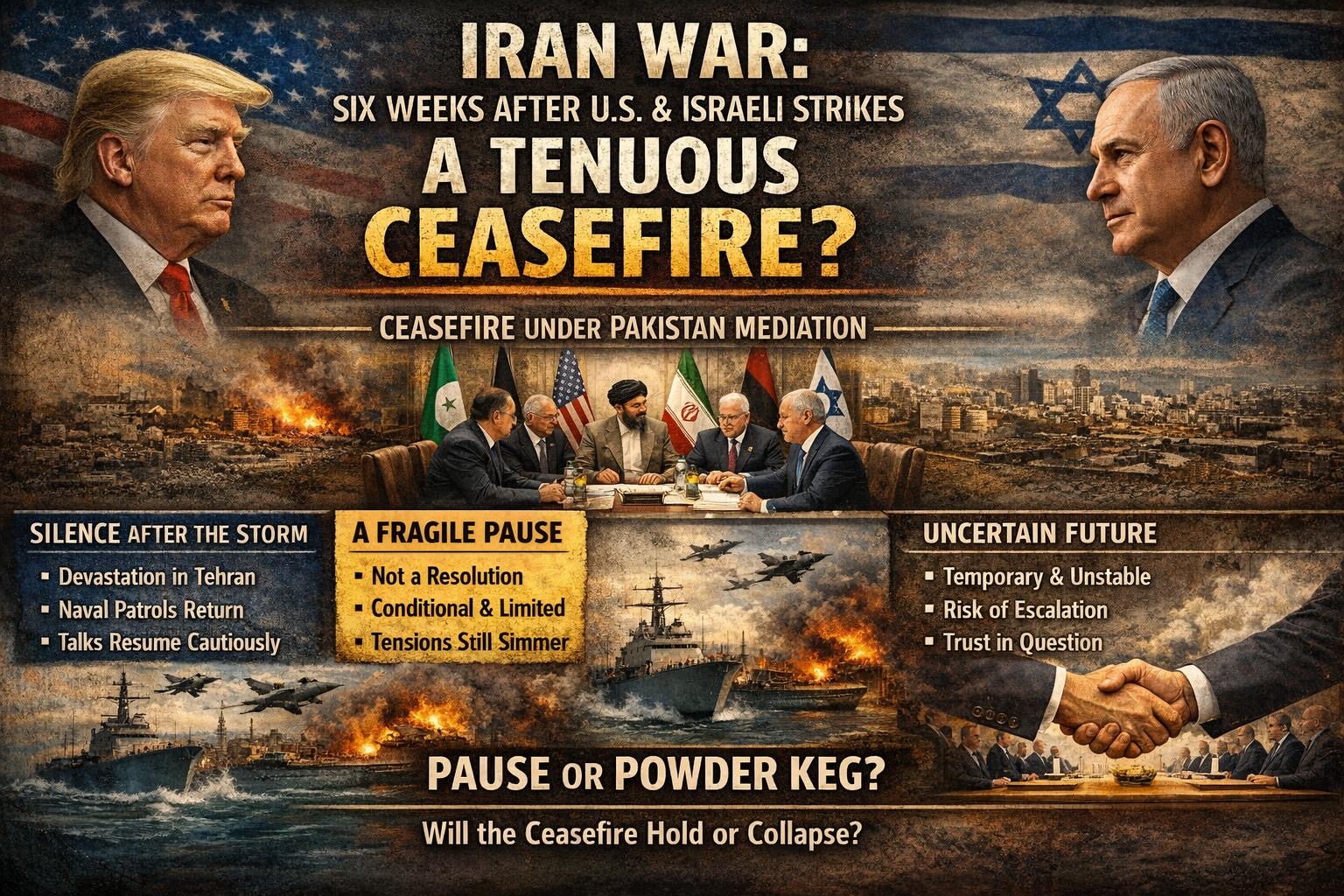
Six weeks after the United States under Donald Trump and Israel led by Benjamin Netanyahu launched coordinated strikes on Iran, a Pakistan-mediated ceasefire that took effect on April 7 has imposed a temporary halt on hostilities. The guns have, for now, fallen silent, maritime traffic has resumed under controlled conditions, and diplomatic channels have reopened. On the surface, this suggests de-escalation. In substance, however, it is something more fragile and far less conclusive. The war has paused. The question is whether it has paused honestly.
This ceasefire is not a settlement. It does not resolve the conflict’s core disputes, nor does it define a political end-state. It is better understood as a structured pause, an arrangement designed to create space for negotiation while preserving each side’s leverage. Its terms are conditional, its duration limited, and its continuation dependent on progress that has yet to materialize. In that sense, it is less an agreement than a mechanism, one that tests whether diplomacy can proceed without being constantly overshadowed, or even shaped, by the implicit or explicit threat of renewed force.
Experience suggests caution precisely because this balance has proven difficult to sustain. Previous diplomatic moments in comparable contexts have often unfolded in parallel with continued military signaling, if not outright escalation. Ceasefires have been used tactically, to regroup, reposition or extract concessions, rather than as genuine steps toward resolution. This history casts a long shadow over the current pause.
The question, therefore, is not simply whether the ceasefire will hold in a technical sense, but whether it will hold in a political sense. Can restraint be maintained even when it appears to weaken immediate bargaining positions? Can negotiations proceed without being punctuated by calibrated strikes meant to alter their direction? If the answer is yes, even partially, the ceasefire could begin to acquire credibility as a pathway to de-escalation. If not, it will reinforce the perception that the war has not truly paused at all, but has merely shifted into a different, more ambiguous phase where diplomacy and coercion continue to operate side by side.
What the ceasefire actually contains
Unlike previous vague “de-escalation understandings,” this ceasefire package is more detailed, but also more conditional, reflecting a deep and accumulated distrust among the parties. The provisions are more clearly articulated, covering not only the suspension of attacks but also maritime arrangements and a defined diplomatic timeline. Yet this greater specificity does not translate into greater confidence. On the contrary, the conditional nature of each element, tied to compliance, sequencing and reciprocal steps, underscores how little trust exists between the actors. Every clause appears calibrated not to build mutual assurance, but to prevent exploitation. The result is a framework that is structurally tighter, yet politically more fragile, designed as much to manage suspicion as to enable peace.
At its core, the arrangement rests on three interlinked pillars:
1. Mutual suspension of direct attacks
2. Conditional reopening of the Strait of Hormuz
3. Sequenced diplomatic track
This is not a classic ceasefire. It is a transactional pause linked to a political roadmap.
Built-in fault lines
Despite its structure, the ceasefire contains vulnerabilities that mirror past failures.
Ambiguity across theaters – Israel has not fully committed to halting operations against Hezbollah. This creates a loophole large enough to trigger escalation even if the core ceasefire holds.
Asymmetry of expectations – Washington appears to treat the ceasefire as a stabilizing mechanism. Iran treats it as a gateway to a comprehensive settlement. These are fundamentally different objectives.
Lack of enforcement mechanisms – There is no independent verification or binding enforcement. Compliance depends on political will, not institutional guarantees.
This explains why Tehran insists on “binding guarantees.” It is reacting not to theory, but to precedent.
Will the ceasefire hold?
The credibility of the ceasefire hinges on whether the United States and Israel alter a pattern that has defined previous negotiation rounds: talking while striking.
There are reasons for skepticism.
Yet there are also countervailing pressures.
The result is a narrow and unstable equilibrium.
Winners and losers: Beyond the slogan
It is essential not to dilute the analytical clarity reached earlier: this war has not produced a clean winner.
However, the ceasefire allows a more refined hierarchy of outcomes.
1. The United States: Tactical dominance, strategic erosion
The United States entered the war with overwhelming military superiority and demonstrated it swiftly. Under the leadership of Donald Trump, U.S. forces, in coordination with Israel, executed high-precision strikes targeting Iranian military infrastructure, nuclear-linked facilities and command networks. In operational terms, Washington achieved what it set out to do in the early phase of the conflict. It established escalation dominance, degraded key Iranian assets and signaled its capacity to project force decisively across the region.
Yet war is not measured only in targets hit, but in political outcomes secured. And it is here that the U.S. position becomes far more ambiguous.
The central, if unofficial, objective of altering Iran’s political trajectory, whether through regime destabilization or coercive realignment, has not been achieved. Tehran has not fragmented. On the contrary, it has consolidated. Iran remains politically intact, its leadership cohesive enough to engage diplomatically while sustaining a posture of resistance.
More importantly, Washington now finds itself engaged in negotiations where compromise is unavoidable. The language has shifted from demands to discussions, from deadlines to frameworks. This reflects a deeper strategic reality. The United States has won the opening phase militarily, but it has not dictated the terms of the endgame.
It is a familiar pattern in modern conflict. Tactical excellence produces immediate results, but without a coherent political roadmap, those results do not translate into strategic closure. The outcome is not defeat, but erosion. Influence is no longer absolute, and leverage must now be negotiated rather than imposed.
2. Israel: Operational success, strategic exposure
For Benjamin Netanyahu, the war has reaffirmed Israel’s capacity for rapid, far-reaching and technologically sophisticated military operations. Israeli forces demonstrated an ability to strike deep into Iranian-linked infrastructure and disrupt networks extending across multiple theaters. This operational reach reinforces Israel’s longstanding doctrine of deterrence through decisive and preemptive force.
However, the ceasefire has exposed the limits of this approach when translated into long-term strategic outcomes. Despite the intensity and effectiveness of its strikes, Israel has not achieved a decisive transformation of Iran’s capabilities or its regional posture.
The pause in operations, imposed before such an outcome could be secured, highlights a gap between operational momentum and strategic completion. At the same time, ambiguity surrounding continued actions in Lebanon underscores unresolved security dilemmas. If operations continue there, the ceasefire risks fragmentation. If they stop, Israel faces renewed concerns about deterrence credibility. This dual pressure reveals a deeper vulnerability.
Israel’s actions, while militarily effective, have also intensified international scrutiny and increased the risk of regional overextension. The country remains a high-impact actor, capable of shaping events rapidly, but it has yet to define a stable strategic endpoint. It is operating with force, but without closure.
3. Iran: Damaged but not defeated, constrained but repositioned
Iran has borne the heaviest direct costs of the war. Its infrastructure has been targeted, its economy further strained and its population exposed to sustained pressure under already existing sanctions. These are not marginal losses. They are real and cumulative.
Yet the strategic picture tells a more complex story. Iran’s primary objective, regime survival, has been achieved. The state has not collapsed under pressure. Instead, it has adapted, mobilized and reframed the conflict as one of resistance rather than vulnerability.
Equally significant is Iran’s diplomatic repositioning. Far from being sidelined, Tehran has emerged as an active participant shaping the terms of negotiation. Its 10-point proposal is not simply a list of demands. It is an attempt to redefine the structure of the endgame by insisting on guarantees, sanctions relief and regional de-escalation as interconnected elements.
This marks a shift from reactive defense to conditional agenda-setting. Iran is no longer merely responding to pressure. It is leveraging the ceasefire to impose a framework for resolution. This does not constitute victory in a conventional sense. The costs remain high and the constraints real. But it represents strategic resilience coupled with retained leverage. Iran has not won the war, but it has avoided losing it in the way its adversaries intended.
4. Global economy: The clearest loser
If one actor emerges as an unequivocal loser, it is the global economic system. The war has exposed the extent to which geopolitical shocks can rapidly destabilize interconnected markets. Energy prices surged sharply during the escalation phase, reflecting fears over disruptions in the Strait of Hormuz, a critical artery for global oil supply. Supply chains, already strained by previous crises, faced renewed uncertainty, and inflationary pressures intensified, particularly in energy-importing economies.
The ceasefire has provided temporary relief, stabilizing prices and restoring a degree of predictability. But this stabilization is conditional and fragile. The underlying risk premium has not disappeared. It has merely been deferred.
Markets now operate with an embedded awareness that disruption can return quickly, and perhaps more severely. This is the lasting impact of the conflict. It is not only the immediate shock, but the normalization of volatility. The system has absorbed damage that will persist beyond the current phase, affecting investment decisions, trade flows and economic planning across regions.
5. Middle powers: Opportunistic gains in a shifting system
In contrast to the major powers, a group of mid-sized and regional actors has found space to maneuver. Pakistan’s role as a mediator in brokering the ceasefire has elevated its diplomatic profile, demonstrating how middle powers can exert influence in moments of great-power tension.
Similarly, countries such as Türkiye, India and Brazil are navigating the evolving landscape with a degree of strategic autonomy that was less visible in more rigid geopolitical configurations.
These gains are not victories in the traditional sense. They do not stem from dominance, but from adaptability. In a system where power is dispersing and alliances are becoming more fluid, the ability to act as a mediator, a balancer or an independent actor becomes a source of influence.
The war has accelerated this trend, creating openings that these countries are beginning to exploit. Their gains are positional, not decisive, but they are nonetheless significant in shaping the contours of the emerging order.
6. The international order: The silent casualty
The most profound loss is not tied to any single country. It is structural.
The war, and even the ceasefire designed to pause it, reflect a broader transformation in how international relations are conducted. The traditional framework of a rules-based order, anchored in institutions, norms and predictable mechanisms, is giving way to a more transactional system defined by power, leverage and negotiated arrangements. Agreements are no longer assumed to be durable. They are provisional, conditional and often reversible.
The ceasefire itself embodies this shift. It is not enforced by an international body or anchored in a binding legal framework. It exists because the parties find it temporarily useful. Its continuation depends not on obligation, but on calculation. This is the deeper implication of the conflict. It signals not just a regional crisis, but a systemic transition.
The erosion of predictability, the weakening of norms and the rise of ad hoc arrangements point to an international environment where stability must be constantly renegotiated rather than institutionally guaranteed.
The real test ahead
The ceasefire has done one thing decisively. It has moved the war from the battlefield to the negotiating table without resolving the contradictions that fueled it.
If Washington and Tel Aviv refrain from striking during talks, even imperfectly, the ceasefire could evolve into a broader framework. If they do not, the ceasefire will validate Iran’s insistence that only enforceable guarantees can work. Either way, the outcome will not be measured in territorial gains or destroyed targets.
It will be measured in whether this pause produces a structure.
Pause without illusion
The temptation is to see the ceasefire as a turning point. It is not. It is an inflection point. It does not resolve the war; it reframes it. The underlying drivers of the conflict, security anxieties, regional rivalries, sanctions pressure and questions of deterrence, remain intact. The strategic balance, meanwhile, is still fluid. None of the principal actors has secured a decisive outcome, and none has conceded defeat. What has shifted is not the end state, but the arena in which that end state will be contested. The battlefield has given way, at least temporarily, to the negotiating table, but the logic of the conflict continues to operate beneath the surface.
In that sense, the winners and losers are not determined by territorial gains or destroyed assets, but by relative positioning within an ongoing process. Who shapes the terms of negotiation, who retains leverage, who absorbs costs without strategic collapse, these are now the meaningful indicators. The ceasefire has redistributed these variables without settling them. It has created space, but not clarity; movement, but not direction.
And that process has now entered its most delicate phase. The ceasefire must demonstrate that it can sustain restraint even in the absence of trust, that it can separate diplomacy from coercion in a conflict where the two have been deeply intertwined. If it holds, it may gradually evolve into a structured de-escalation. If it fails, it will confirm that the pause was merely tactical, a brief interlude before escalation resumes with greater intensity and fewer constraints. The real test, therefore, is not whether the guns have fallen silent, but whether they remain so long enough for politics, rather than force, to begin defining the outcome.