



Persistent reports of royal disquiet about the role of the king’s favored son indicate that a showdown between rival factions may be imminent.
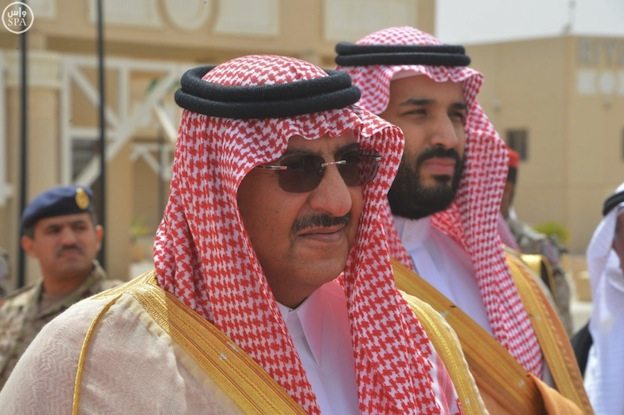
Saudi Arabia’s leadership has been in turmoil since January, when King Abdullah died and was succeeded by Crown Prince Salman, who promptly promoted his twenty-nine-year-old son Muhammad to minister of defense. The status of MbS, as he is known, was further enhanced three months later when the king named him deputy crown prince. The nominal heir apparent is King Salman’s nephew, Crown Prince and Interior Minister Muhammad bin Nayef, or MbN, age fifty-six. But MbS is clearly closer to the king and is widely believed to be his true intended successor. The resultant tensions have the wider royal family and the public worried — a sentiment exacerbated by concerns about the cost of the Yemen war and the low price of oil, both of which are forcing government cutbacks.
How the tensions will play out is a matter of speculation. The laconic MbN, a favorite of Washington because of his counterterrorism cooperation, sometimes cuts a sorry figure alongside the brash, self-confident MbS, who last week flew to Russia for negotiations with Vladimir Putin over Syria and, most likely, oil policy. Although he seemed deferential toward his cousin at first, MbS now projects disdain (e.g., an official photo of a meeting that MbN chaired in Mecca after the recent pilgrimage stampede disaster showed MbS reading a magazine).
Meanwhile, two widely reported letters circulated by an anonymous Saudi prince have called on royal family members to stage a coup against King Salman, while also alleging that his son’s policies are leading the kingdom to political, economic, and military catastrophe. The unnamed prince, whose identity is a matter of considerable speculation, could well be acting as a front for other family members. In one report, he is quoted as favoring the king’s younger full brother Ahmed for the throne, though his qualifications seem poor — Ahmed is widely viewed as a nonentity who was passed over for the role of crown prince by both King Abdullah and King Salman.
Another element of the crisis is the king’s poor health. At age 79, Salman suffers from many ailments, walks with a stick, and has shown deteriorating mental ability — a fact now widely acknowledged, though not publicly, by many Western officials. He is said to have good days and bad days; his conversation is reportedly repetitive, and the royal court goes to elaborate lengths to cover for this deficiency by often positioning a teleprompter in front of him, obscured by elaborate floral arrangements.
In light of these factors, several scenarios are possible:
* King Salman dismisses MbN as crown prince and appoints MbS in his place. This could prompt a military standoff between the Saudi army, under MbS, and the Interior Ministry’s considerable paramilitary forces under MbN — the latter perhaps supported by the Saudi Arabian National Guard, whose commander is Prince Mitab bin Abdullah, a son of the late king and perceived ally of MbN.
* King Salman relinquishes his dual post as prime minister and names MbS to the position, making deputy prime minister MbN subordinate to his younger cousin. The elder prince already suffers similar indignities elsewhere in government: although MbN chairs the important Council of Political and Security Affairs, MbS holds a seat there as well; meanwhile, the king’s son chairs the other main decisionmaking body (the Council of Economic and Development Affairs, which controls the crucial oil portfolio), from which MbN has been excluded.
* MbN and MbS try to force each other’s ouster. MbN’s weak spot is the huge death toll during last month’s Hajj pilgrimage, the organization of which was his direct responsibility. And MbS could be vulnerable over the Yemen war, an initiative that apparently remains popular in the kingdom but is viewed as adventurist by Washington; whatever the case, a clear-cut military and diplomatic success there seems elusive.
* The House of Saud is forced to cede some or total control to nonroyal senior military figures, who are exasperated by the inexperience and incompetence of royal leadership and have the backing of their troops, who may regard the Yemen war as folly.
A deciding factor in all but the last scenario would probably be the role of the senior princes on the Allegiance Council, a succession-related body that has been sidelined during King Salman’s elevation of MbS. The council would have to balance its sense of the royal family’s long-term future against the short-term perception that the leadership is imperiling the House of Saud’s ruling legacy and future prospects in Arabia.
For the United States, the crucial dimension of any Saudi crisis is, as always, the potential effect on world oil supplies and prices. The surge in U.S. production led by shale oil has altered Washington’s sense of vulnerability, though Saudi chaos leading to supply disruption would still damage the global economy. President Obama may be tempted to use any opportunity presented to advance his idea of strategic balance between Sunnis (led by Saudi Arabia) and Shiites (led by Iran). This would be risky, however: Iranian pilgrims topped the casualty list in the Mecca tragedy, and Tehran is contemptuous of MbS, referring to him as an “inexperienced youngster.” To the extent that Washington can influence outcomes, it should instead look for stability in the kingdom and the broadest acceptable leadership.
Simon Henderson is the Baker Fellow and director of the Gulf and Energy Policy Program at The Washington Institute.