



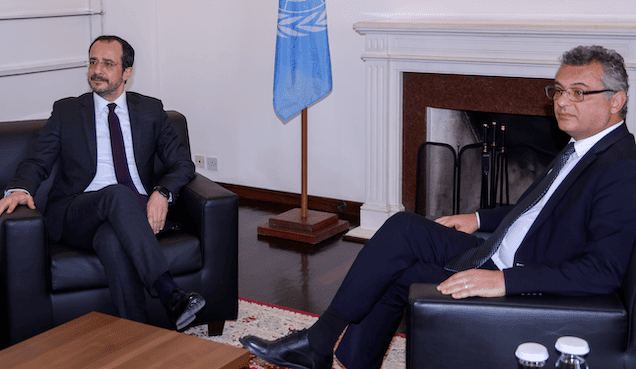
As Turkish Cypriot and Greek Cypriot leaders meet again with no breakthrough in sight, Cyprus remains trapped between dialogue and deadlock, with deepening regional tensions, unilateral moves, and a persistent lack of political will raising the risk that the process itself is losing relevance.
As Turkish Cypriot leader Tufan Erhürman and Greek Cypriot leader Nikos Christodoulides prepare to meet for the fifth time since October 2025, expectations remain deliberately low. Nearly nine years after the collapse of talks at Crans-Montana talks, the Cyprus question continues to drift between cautious engagement and structural paralysis.
Monday’s meeting at the old Nicosia airport will once again take place under the quiet facilitation of the United Nations Peacekeeping Force in Cyprus, reflecting a process that has become more about managing the absence of conflict than resolving it.
A dialogue without movement
The repeated meetings between the two leaders have produced what diplomats describe as “process without progress.” Both sides insist they are ready to move forward, yet each expects the other to demonstrate the necessary political will first.
From the Turkish Cypriot perspective, Erhürman’s approach is methodical and incremental. His emphasis on confidence-building measures, particularly the opening of new crossing points, reflects a belief that trust cannot be negotiated abstractly but must be built through tangible improvements in daily life.
His remark following his February meeting with António Guterres in New York captures this logic succinctly. Leaders who cannot agree on opening crossing points, he argued, cannot credibly claim readiness to negotiate a comprehensive settlement.
Yet, critics argue, this logic, while coherent, runs into a structural limitation. Confidence-building measures have historically functioned as supplements to political negotiations, not substitutes. Without a parallel political horizon, CBMs risk becoming ends in themselves rather than stepping stones toward a settlement.
Crossing points as political symbols
The debate over new crossing points illustrates how even technical issues are deeply politicized. What appears on the surface as a logistical disagreement over roads and routes is, in reality, a reflection of competing sovereignty narratives.
The Turkish Cypriot side prioritizes relieving congestion at Metehan (Ayios Dhometios) crossing point and proposes a package that includes Haspolat (Mia Milia), Kiracıköy (Athienou-Pyroi), Akıncılar (Louroudjina-Lymbia) and the Kiracıköy–Ağlanda (Pyroi-Aglandja) crossings.
The Greek Cypriot side, meanwhile, frames the issue in terms of reciprocity and balance, insisting that any arrangement must yield visible benefits for Greek Cypriots. Erhürman, by contrast, emphasizes that the priority should be addressing the practical needs of people on both sides, arguing that calculations over who benefits more, or attempts to extract territorial advantage from the Turkish side or the buffer zone, should be set aside.
The dispute over whether the Kiracıköy–Ağlanda route constitutes a separate crossing point is not merely semantic. It reflects deeper disagreements over how space, authority and legitimacy are defined on the island. Equally contentious is the route itself. Whether a road should pass through the buffer zone, remain in the north, or be constructed in the south with EU funding has become a proxy for broader political positioning.
In this sense, the crossing points issue has evolved into a microcosm of the Cyprus problem. Even limited cooperation becomes entangled in questions of recognition, control and narrative framing.
Competing roadmaps to negotiations
Beyond CBMs, the gap between the two sides widens significantly on the question of substance.
Erhürman’s four-point methodology seeks to avoid a repetition of past failures. It calls for prior agreement on political equality, preservation of past convergences, a defined timeframe, and a guarantee against returning to the status quo if talks collapse.
Christodoulides, by contrast, advocates a five-point framework that begins with recording positions and convergences, followed by a resumption of talks through an expanded “5+1” format involving guarantor powers.
These are not simply procedural divergences. They reflect fundamentally different interpretations of why the Crans-Montana talks collapsed and what is needed to prevent another failure. For the Turkish Cypriot side, the experience of inconclusive negotiations stretching back to 1968 has reinforced the view that ambiguity and open-ended processes inevitably lead to deadlock. The Greek Cypriot side, by contrast, continues to favor a return to a structured negotiation framework under UN auspices.
From the Turkish Cypriot perspective, shaped by repeated breakdowns over decades, this approach is often seen as enabling a process that appears active on the surface while effectively preserving the status quo without meaningful cost. Accordingly, Turkish Cypriots argue that any renewed talks must include clear safeguards. If a new process is launched, there should be an understanding that the party responsible for a breakdown faces consequences, and that a return to the existing status quo is no longer an option.
The outcome is a familiar diplomatic impasse, where each side’s remedy for past failures is viewed by the other as a built-in advantage.
The Guterres variable
Into this stalemate enters a new, still undefined element. Following separate meetings with both leaders, Guterres has reportedly outlined a different approach aimed at breaking the deadlock.
Details remain scarce, but the emphasis appears to be on sequencing. Building trust first, demonstrating commitment to the international community, and then moving toward a renewed negotiation process.
This aligns more closely with the Turkish Cypriot emphasis on gradualism, yet it also leaves room for the Greek Cypriot preference for a structured negotiation format.
Whether this “Guterres approach” can bridge the gap depends on one key factor. Political will.
Without it, even the most carefully designed framework risks becoming another addition to the long list of unrealized initiatives.
A changing regional context
What makes this moment particularly significant is that the Cyprus issue is no longer insulated from regional dynamics. Since the last leaders’ meeting, the Eastern Mediterranean has entered a period of heightened volatility. The war involving the United States, Israel and Iran has expanded across multiple theaters, military deployments around Cyprus have increased, and competition over energy routes has intensified. This evolving environment is directly shaping the island’s strategic outlook.
Despite sustained Turkish Cypriot objections that such initiatives cannot legitimately proceed without their consent as co-partners, the Greek Cypriot administration continues to advance hydrocarbon exploration unilaterally, aiming to link offshore resources with Israeli gas and deliver them to Europe via LNG or pipeline networks. From a Turkish Cypriot and broader Turkish perspective, this is not simply an economic policy but part of a wider effort to consolidate the Greek Cypriot administration’s position as the sole authority on the island while embedding the south more deeply into emerging regional security and energy frameworks.
This approach reinforces long-standing Turkish Cypriot concerns over political equality and partnership. As co-founders of the 1960 Republic, Turkish Cypriots maintain that they retain inherent rights over natural resources and that unilateral development disregards this status. In their view, hydrocarbon activity has become a political instrument, signaling reluctance to engage in genuine power-sharing and instead strengthening an all-Greek governance structure under the guise of ongoing negotiations.
The pattern feeds a broader skepticism rooted in decades of failed talks. For many Turkish Cypriots, it suggests that the goal is not a partnership-based settlement but the gradual normalization of the existing asymmetry. This perception continues to erode trust and complicate any return to meaningful negotiations.
Recent developments linked to the Iran war have added a sharper security dimension. The increase in European military deployments on and around the island, presented as protective measures following drone and missile threats, is viewed with caution in Turkish Cypriot and Turkish circles. Efforts to leverage the regional crisis to establish a more permanent EU military presence are widely interpreted as politically driven moves that could alter the strategic balance. Such steps are seen as hostile and ill-intentioned if pursued without Turkish Cypriot involvement, raising concerns that deeper militarization could entrench division, heighten tensions and expose the island to broader regional risks.
In parallel, Türkiye’s relatively restrained posture in energy exploration, despite its significant drilling and seismic capacity, points to a broader strategic calculation. At the center of this calculus lies the evolving relationship between Türkiye, Israel and the United States. Statements by Donald Trump and recent high-level contacts suggest that a pragmatic recalibration remains possible. Should Türkiye and Israel move toward a more functional relationship, particularly in energy, the implications for Cyprus could be far-reaching, with economic interdependence potentially creating new incentives for cooperation and reshaping the parameters of the Cyprus issue.
Strategic realism and its limits
From a Turkish analytical perspective, the current situation reveals a layered reality. On the surface, the leaders’ meetings continue, the UN remains engaged, and the language of dialogue is preserved. Beneath that surface, however, the structural conditions for a breakthrough remain absent.
The Cyprus problem today is not only a question of political models, whether federation, confederation or two states. It is increasingly embedded in a broader geopolitical matrix that includes energy competition, regional conflicts and shifting alliances. This creates both constraints and opportunities. Constraints, because local actors are influenced by external dynamics they cannot fully control.Opportunities, because changes in the regional environment can open new pathways that were previously unthinkable.
Waiting for movement
As Erhürman and Christodoulides meet once again, the fundamental question remains unchanged.
Who will move first? Or perhaps more accurately, whether both sides can move simultaneously without perceiving that they are conceding ground.
For now, the most likely outcome remains another “open and frank exchange,” followed by carefully worded statements and a continuation of the process.
Yet time is not neutral. With each passing month, the gap between process and outcome widens. Regional dynamics evolve. Energy projects advance. Political realities harden.
In that sense, the real risk is not that talks fail. It is that they become increasingly irrelevant.
For Türkiye, this evolving landscape reinforces the need for strategic clarity. Whether through engagement, recalibration or alternative frameworks, Ankara’s choices will play a decisive role in shaping the next phase of the Cyprus issue.
The meeting on Monday may not produce a breakthrough.
But it will take place against a backdrop where the cost of continued stalemate is steadily rising, and where the question is no longer whether change will come, but in what form.