



The prospect of a big payday for its regional rival, Iran, is spurring Saudi Arabia to a quicker plan of action on Yemen and Syria, officials and analysts say.
The nuclear deal that will lift tough sanctions on Iran is mobilizing Saudi Arabia to turn the tide against its regional rival in Yemen and Syria before it makes an economic recovery, military officials and analysts say.
According to the sources, the military component of the Saudi offensive will include the use of special forces on the ground in Yemen, and a potentially widened use of Saudi and allied Sunni air power in Syria.
The Saudis have signaled their intent to employ ground forces in Yemen previously, but have not done so. But the potential military initiatives, coupled with signs that the Saudis are cultivating better diplomatic ties with Russia and China, would be a strong indication of how the Iran nuclear deal could impact the regional order in the Middle East.
While many Arab leaders, including UAE President Sheikh Khalifa, were quick to welcome Tuesday’s historic deal bringing Iran back into the international fold, Saudi Arabia’s silence spoke volumes.
Rather than reporting remarks from King Salman, the state-run Saudi Press Agency carried a short statement attributed to an “official source” maintaining that Saudi Arabia was “always in favor of an agreement between Iran and the P5+1 group [the US, France, China, Russia, the UK, and Germany]” but stressing the need to continue “the sanctions on Iran for its support of terrorism.”
State-run newspapers were even more critical of the deal. The “Riyadh” warned that the lifting of sanctions will allow Iran to “persist in its expansionist policies and extend their influence in the Arab region” and “spread conflict” – a theme that has become the Saudi narrative.
“An Iran without sanctions will pump billions of dollars to its proxies, which are destabilizing Yemen, Syria, and Iraq,” says Jasser al Jasser, managing editor of the pro-government Al Jazeerah daily. “Saudi Arabia will not allow Iran to take advantage of this deal.”
According to the military officials and analysts, the nuclear deal has left the Saudis scrambling to make as many battlefield gains in neighboring states as possible before sanctions are lifted over the next year, potentially leaving Iran flush with more than $100 billion in unfrozen funds and new revenues – resources they say Tehran will use to expand its proxy wars.
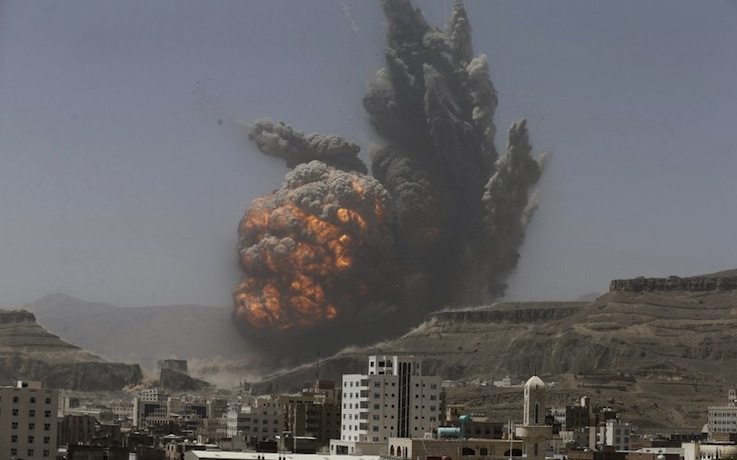
The first priority for Riyadh’s new offensive is Yemen, observers say, where it has been embroiled in a mostly ineffectual but deadly four-month campaign of airstrikes to secure a foothold for the pro-Saudi government of Abed Rabbo Mansour Hadi, currently in exile in Saudi Arabia.
“Yemen is the red line for Saudi Arabia. We will see military escalations in Yemen in the coming days in order to prevent what Saudi sees as an Iranian foothold in the Gulf,” says Mustafa Alani, director of security and defense studies at the Jeddah-based Gulf Research Center.
FIRST YEMEN, THEN SYRIA
Buoyed by this week’s gains by pro-government forces, who seized the airport and other neighborhoods in Aden, and pressured by the Iranian deal, Riyadh is set to dispatch dozens of special forces to Yemen to take part in a ground fight to capture and secure the southern port city, military officials say.
“The tide of the war is turning, and the coalition is prepared to take the next step to secure southern Yemen,” says a Saudi official close to the operation but who is unauthorized to speak to the press.
According to military officials and observers, once the Saudi-led coalition makes headway in Yemen, Riyadh and its Sunni allies will shift their focus to Syria, where Iran has dispatched an estimated 7,000 troops and is providing billions of dollars in annual support to the regime of President Bashar al-Assad.
“If the coalition is successful in Yemen, we will very likely see it entering Syria,” Mr. Alani says, referring to the Sunni alliance of Saudi Arabia, Qatar, the UAE, Egypt, and Kuwait.
Saudi military officials refused to discuss in detail any potential plans for Syria, adding only that Riyadh is willing to use air power to provide cover for the anti-Assad Free Syrian Army, which currently receives funding and arms from the Saudis, and to target “Hezbollah and Iranian targets.” Until now the Saudi Air Force has engaged in limited sorties against Islamic State targets in Syria.
DIPLOMATIC SHIFT
Concerns that Saudi Arabia has communicated privately to the United States have been enough to prompt US Defense Secretary Ashton Carter to announce a trip to Riyadh designed to allay the House of Saud’s fears and avert any military escalation.
However, observers say the visit will not be enough to prevent a fundamental shift in Saudi foreign policy. Analysts say Riyadh will now put substantial resources and effort into its own diplomacy to expand its influence beyond the US and Europe – namely with Russia and China.
“You have heard the word ‘diversify’ recently in relation to Saudi foreign relations, and the Obama administration has brought home the thought that Saudi must branch out and see the support of other powers,” says Salman Sheikh, director of the Brookings Doha Center.
“With this deal, Saudi by necessity will reach out to other world powers,” he says. “Now the only question is how Russia and China will respond.”
READY TO GO ALL-IN?
The shift began in the lead-up to the nuclear deal, with Deputy Crown Prince Mohammed bin Salman making a high-profile visit to St. Petersburg in June and inviting Russian President Vladimir Putin to Riyadh.
Now, rather than sending a “warning signal” to the US, officials say Riyadh is preparing to go all-in, embarking on a full diplomatic push to build alliances with Moscow and Beijing. The hope, Saudi officials say, is that in return for oil supplies as well as trade and investment opportunities – such as the government’s $10 billion investment in the Moscow-controlled Russian Direct Investment Fund this month – Russia and China would lessen their support for Iranian-backed Shiite proxies in Syria and Yemen.
“After four decades, we are finally realizing the importance of world powers beside the US – and this is the key to ending the Iranian-supported conflicts in the region,” the Saudi military official said.
“If Iran can expand its influence in the region through diplomacy and negotiations, so can we.”
Christian Science Monitor